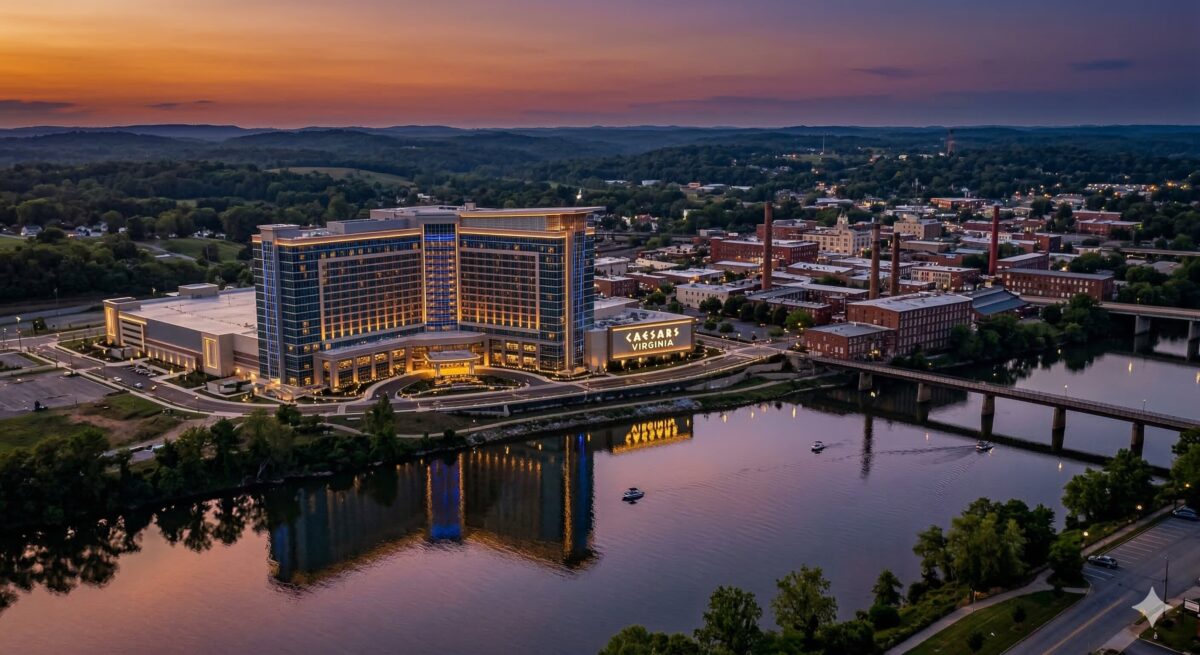


Five years ago, Danville, Virginia was a city still carrying the economic weight of its collapsed tobacco and textile industries — a place where storefronts stayed empty and young residents left. In February 2026, the Caesars Virginia resort sitting on its redeveloped riverfront generated $31.8 million in a single month of gambling revenue. That’s more than Danville’s entire annual budget from local tax sources just a decade earlier. Multiply that story across four other Virginia cities, and you have the arc of one of the fastest-growing regional casino markets in the United States.
According to Virginia Lottery data released on March 13, Virginia’s five operating casino venues collectively posted $95.2 million in adjusted gaming revenue (AGR) for February 2026 — up 26.6% from the $75.17 million reported in February 2025, and up 17.5% from January’s $81.02 million. The February figure is the highest single-month total the state has ever recorded, and it arrived with two permanent casinos still under construction.
The February report covers three permanent casinos and two temporary venues — each at a different stage of development, drawing from different regional markets, and telling a distinct story about demand.
Caesars Virginia led the state for the third straight month. The Danville resort, which opened its permanent facility in December 2024, generated approximately $31.82 million in AGR — roughly $23.05 million from its 1,497 slot machines and $8.77 million from 94 table games. Since casino operations began with a temporary facility in May 2023, Caesars Virginia has produced nearly $800 million in cumulative gaming revenue, and the city of Danville has received about $54 million in gaming tax payments over that period. That’s $54 million flowing into a city whose entire local revenue base was $72 million annually at the time Virginia authorized casinos, according to the Joint Legislative Audit and Review Commission’s original feasibility analysis.
Rivers Casino Portsmouth, Virginia’s first permanent casino, reported $26.42 million in February AGR — $18.44 million from slots and $7.98 million from its 84 table games. Its numbers are steady rather than spectacular, which reflects a maturing property finding its ceiling in the Hampton Roads market rather than still ramping up.
Hard Rock Hotel & Casino Bristol posted $20.92 million, with $17.06 million from slots and $3.86 million from 73 tables. Bristol’s performance remains geographically counterintuitive — southwest Virginia is among the state’s least populated regions, yet the Hard Rock consistently outperforms urban market expectations by drawing heavily from Tennessee and the broader Appalachian corridor.
The two newcomers add a different dimension. The temporary Live! Casino in Petersburg, which opened January 22, generated $15.02 million in its first full month — $11.21 million from 926 slots and $3.81 million from 32 table games. That’s a strong debut for a tent-based interim structure. Petersburg sits 25 miles south of Richmond, a metro of 1.3 million people with no casino of its own; that geography is doing much of the work. The permanent $1.4 billion Live! Casino & Hotel is projected to create 7,500 jobs and generate $504 million in total tax revenue over time, with $240 million remaining in Petersburg.
Norfolk’s temporary Interim Gaming Hall, operating with just 132 slots and no table games, posted $975,609 for the month — intentionally limited as a placeholder ahead of a permanent $750 million casino being developed by Boyd Gaming and the Pamunkey Indian Tribe, anticipated to open in 2027.
The tax math behind Virginia’s casino revenue is more nuanced than a flat rate, and it matters for understanding the long-term fiscal stakes.
Virginia law applies a graduated tax structure: 6% of a casino’s AGR goes to its host locality until the operator crosses $200 million in annual AGR, at which point the rate rises to 7%, and to 8% above $400 million. For February, all five venues remained at the 6% tier, producing a combined $17.13 million in taxes. Danville received $1.91 million from Caesars Virginia’s AGR; Portsmouth netted $1.59 million from Rivers. Bristol’s share went to the Southwest Virginia Regional Improvement Commission, which distributes funds across 14 localities — a design that turns a single casino into a regional economic instrument.
Step back further and the annual picture becomes more striking. According to Virginia Business, total 2025 casino taxes reached approximately $192.3 million across all three permanent properties, with Caesars Virginia alone generating $80.6 million in annual gaming taxes and Danville receiving $25.6 million of that. The JLARC projection at the time of legalization estimated all five authorized casinos would together generate approximately $260 million in annual state gaming tax revenue Virginia Business at full build-out. With two properties still temporary and two others not yet open, Virginia is already approaching half that figure — years ahead of the original schedule.
The most analytically significant number in February’s report isn’t Caesars Virginia’s $31 million — it’s the $15 million generated by a temporary Petersburg casino in its first 28 days of operation.
Consider what that figure represents structurally: a tent structure with 926 slot machines and 32 table games outperformed industry models for a first-month temporary facility. The only coherent explanation is demand leakage from Richmond. For years, Richmond-area residents who wanted to gamble had to drive to Maryland, West Virginia, or the North Carolina border. Petersburg — just off I-85, 25 miles south of downtown Richmond — has inserted itself directly into that travel pattern.
If the temporary venue is already clearing $15 million monthly, projections for the permanent $1.4 billion Live! Casino become considerably more credible. The Cordish Companies, which is developing the property, has long argued that the Richmond metro represents one of the most underserved large-market gambling populations on the East Coast. February’s data supports that claim with actual revenue rather than just consultant modeling.
Virginia’s casino revenue headline is strong. What it doesn’t capture is the degree to which the market’s growth is coinciding with unresolved structural questions that could reshape the landscape significantly.
The most immediate is iGaming. The Virginia House and Senate both passed online casino bills in early 2026, and a conference committee is working to reconcile the two versions before the legislative session ends. Both chambers agreed on a 20% tax rate on iGaming adjusted gross revenue, but disagreements over how to distribute a 6% hold-harmless fund — designed to compensate brick-and-mortar casinos and the iLottery for potential cannibalization — remain unresolved. If that reenactment clause holds, Virginia would need to pass matching legislation again in 2027 before online casinos could legally operate.
The cannibalization concern is not theoretical. A Virginia Lottery fiscal analysis found that states operating both iLottery and iGaming see lower iLottery sales and slower growth compared to states with only iLottery Virginia — a finding that matters because Virginia’s lottery proceeds fund K-12 education. Through the first nine months of 2025, Virginia’s casinos generated about $830 million in gaming revenue, producing $157 million in taxes — $104 million of which went into a school construction fund. Introducing iGaming without a carefully calibrated hold-harmless mechanism could divert revenue away from one of the market’s most politically important beneficiaries.
Meanwhile, the Fairfax County casino bill — backed by Senate Majority Leader Scott Surovell — advanced through a House committee in late February 2026, though delegates representing Fairfax opposed it. A casino in Tysons or a similar Northern Virginia location would be categorically different from every other Virginia property: drawing from a population base of 2.5 million within a 30-minute drive, with proximity to the DC tourism market. The JLARC analysis noted that such a property could double or triple the state’s current casino tax yields. Whether it ever materializes remains an open question.
Virginia’s casino industry is accelerating. That’s the straightforward read. The less comfortable observation is that rapid, multi-front expansion creates regulatory and fiscal complexity that Virginia’s current oversight structure wasn’t designed to handle.
The gaming industry donated over $14 million to Virginia political candidates from both parties during 2024 and 2025, according to Virginia Public Access Project data — including more than $1 million to Governor Spanberger. That level of political spending, while legal, creates pressure dynamics that can complicate dispassionate regulatory decision-making.
The state also lacks a unified gaming regulator. Casinos, horse racing, charitable gaming, and sports wagering are currently supervised by different bodies. Both chambers have been debating whether to consolidate oversight under an expanded Virginia Lottery or create a new, independent gaming commission — with the Senate favoring the former and the House the latter. The disagreement is structural rather than ideological, but it leaves Virginia in an unusual position: a state with nearly $1 billion in annual casino gaming revenue and no single regulatory authority with a full-market view.
There is also the problem gambling dimension. Virginia’s casino tax structure already directs a small share of revenues to the Problem Gambling Treatment and Support Fund — 0.8% of total taxes under current law. But treatment infrastructure in markets like Danville and Bristol remains thin relative to the volume of gambling now occurring there. Public health researchers have documented that problem gambling prevalence rises in the 12–36 months following a new casino opening in a community; Virginia now has multiple such openings in rapid succession.
The February revenue report answers one question definitively: Virginia’s casino market is real, durable, and growing faster than anyone in the 2020 legislative debate predicted. What it opens is a harder set of questions — about regulatory design, iGaming timing, cannibalization risk, and whether the political economy around $14 million in industry campaign contributions can produce sound policy rather than just favorable legislation.
The $95.2 million monthly figure is a milestone. The more consequential number will be whatever Virginia’s casino market looks like in 2028, when all five permanent properties are operating, the iGaming question is settled, and the Fairfax County debate has run its course. At that point, the commonwealth will know whether it built a well-governed industry or simply a fast-growing one.