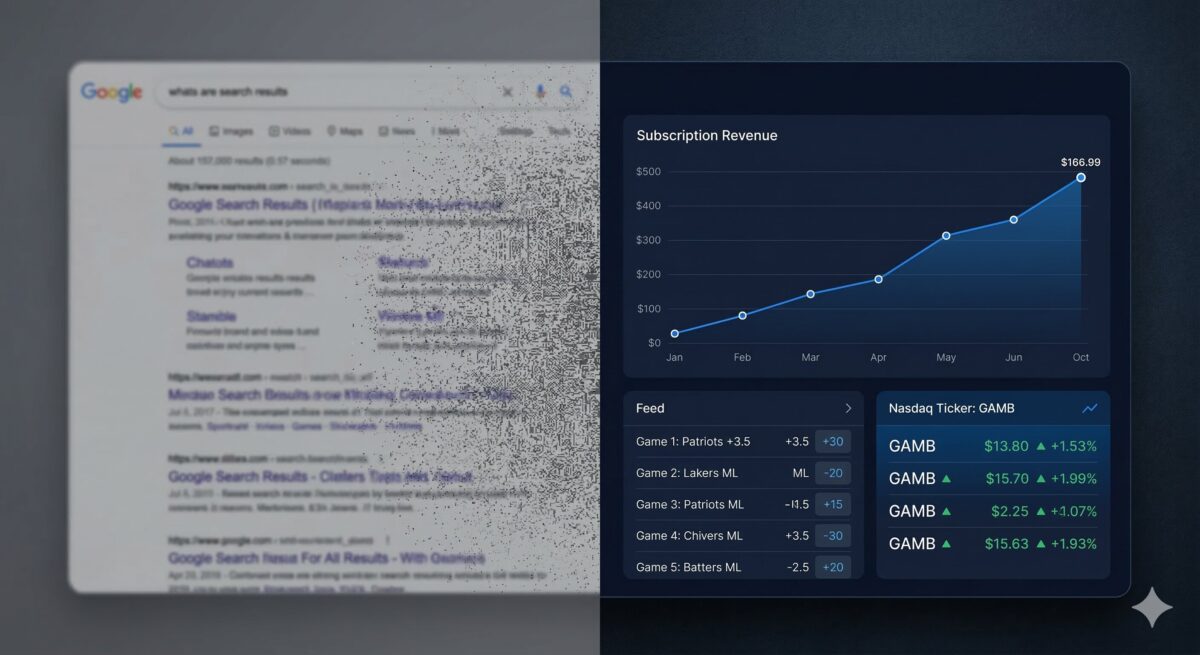


When Gambling.com Group (Nasdaq: GAMB) reported full-year 2025 results on March 12, the headline number looked clean: revenue rose 30% to $165 million for the year, with adjusted EBITDA increasing 19%.
For a Charlotte-based affiliate and data company competing in the hypercompetitive US iGaming market, that reads like a win. It is — but only partly. Dig into the quarterly filings and earnings transcript, and a more complicated picture emerges: a company that hit its revenue targets while simultaneously watching one of its core growth engines stall.
For years, Gambling.com’s marketing services division ran on a straightforward model: rank high on Google for terms like “best online casinos in New Jersey,” funnel sports bettors and casino players toward licensed operators, and collect a referral fee per new depositing customer (NDC). It worked brilliantly — until it didn’t.
In Q4 2025, NDCs — the company’s primary volume metric for its marketing business — fell 32% year-over-year to 98,000, reflecting volatile search dynamics. That is not a minor blip. A 32% drop in customer referrals, in a quarter that includes the NFL regular season and pre-Super Bowl sports betting traffic, is a meaningful structural signal.
Management traced the disruption primarily to Google search volatility rather than AI-driven referrals, even as LLM-sourced traffic grew substantially quarter-over-quarter.
The irony is sharp: despite missing on NDC counts, marketing revenue still rose 4% year-on-year in Q4 Gambling Insider, as the company leaned harder into revenue-share arrangements and non-organic traffic channels. More than half of total Q4 revenue now originates from sources other than organic search — the first time that threshold has been crossed. The affiliate model is not broken, but its original engine is being replaced mid-flight.
While Google throttled one revenue stream, the company’s 2025 acquisition of OpticOdds and OddsJam — closed January 1, 2025 — injected a fundamentally different kind of revenue into the mix. Sports data services revenue grew 440% year-over-year in Q4 to $11.8 million, driven primarily by contributions from OpticOdds and OddsJam. That figure is partly an acquisition effect, but the organic growth within those platforms — enterprise data feeds to sportsbooks, odds comparison tools for consumers — is real and recurring.
Subscription revenue reached 26% of total Q4 revenue, its highest share yet, while recurring revenue (including revenue-share marketing arrangements) accounted for 47% of the quarter. For a company historically dependent on transactional, click-based affiliate fees, this shift toward subscription revenue is the single most consequential strategic development of 2025. Subscription revenue is predictable, margin-accretive, and far less exposed to Google algorithm updates.
The company took a $14 million noncash impairment charge in Q4, driven by revised cash flow expectations for Finnish-targeted websites following regulatory changes in Finland. That charge pushed the company into a net loss for the full year — a notable contrast to the profitable FY2024. Gambling.com Group achieved 30% revenue growth in 2025 but slipped to a net loss due to impairments and earn-outs.
This is worth unpacking. The Finnish regulatory tightening — part of a broader European push to limit performance marketing in iGaming — rendered previously valuable SEO assets essentially worthless overnight.
The company built digital properties targeting Finnish bettors; those properties now generate materially less cash. Writing them down was the correct accounting decision, but it underlines a risk that gets underweighted in affiliate-sector analysis: geographic regulatory concentration. A single regulatory change in a mid-sized European market cost Gambling.com $14 million in paper value.
Gambling.com Group expects 2026 full-year revenue of $170 million to $180 million and adjusted EBITDA of $50 million to $58 million, with revenue growth driven by data services and enterprise sports data services continuing to expand fastest.
The revenue range looks modest — essentially flat to slight growth. But the EBITDA guidance is more striking: adjusted EBITDA of $50–58 million compares to approximately $65 million in 2025, implying meaningful margin compression. The company flagged continued poor search dynamics, UK gaming duty increases affecting player values, and new Finnish regulations curtailing performance marketing as the primary headwinds.
This is a deliberate trade-off: invest now in traffic diversification and sports data infrastructure, accept lower near-term margins, and build a more durable revenue base. The bet is rational — but it will test investor patience in 2026.
The pivot narrative is compelling, but two numbers deserve scrutiny. First, the full-year NDC count for 2025 declined materially from 2024 levels — not just in Q4. An affiliate business that delivers fewer new customers to sportsbooks over a full calendar year, in a US market where regulated states continue to expand, is not simply battling Google; it may be losing competitive ground to direct operator marketing budgets and rival affiliates.
Second, the 2025 EBITDA margin of roughly 39% came in below the 40%+ targets set at the start of the year, and the 2026 guidance implies further compression toward the low-to-mid 30s. For a business repositioning itself as a “high-margin, high-visibility” data platform, tightening margins requires explanation, not just reassurance.