Picks
Sportsbooks
Casino
Promos
Prediction Markets
Lottery
Guide
Gambling is prohibited for underage individuals | Commercial content | Regional restrictions may apply | T&Cs apply | Play responsibly

Baseball’s New Betting Frontier: Inside MLB’s High-Stakes Bet on Prediction Markets

Hardik Dhawan

In late 2025, two Cleveland Guardians pitchers were indicted over allegations of manipulating in-game outcomes tied to betting markets—a scandal that exposed how fragile sports integrity can be in the age of micro-wagers. Just months later, Major League Baseball has made a striking move: partnering with Polymarket while simultaneously aligning with a federal regulator. The message is clear—if betting can’t be contained, it must be engineered.

A League Steps Into Finance, Not Just Gambling

Major League Baseball’s new multi-year deal with Polymarket marks a structural shift: the league is no longer just tolerating betting—it is helping define a new category of it.

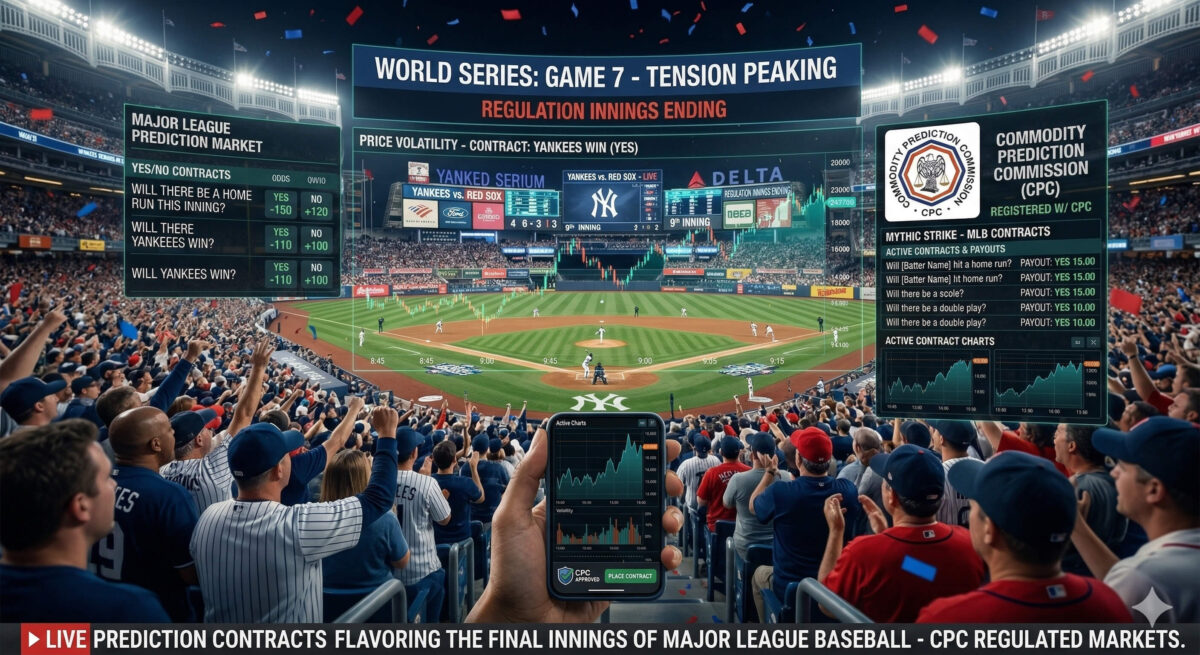
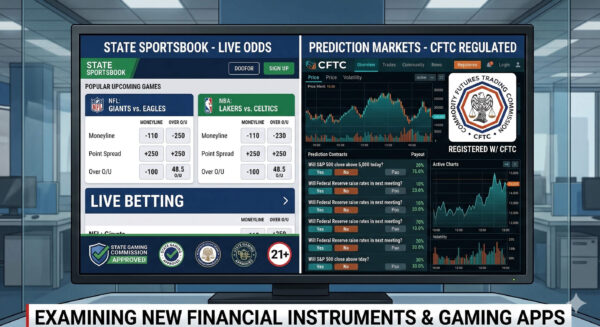
Unlike sportsbooks, where bettors wager against a house, prediction markets allow users to trade contracts with each other based on real-world outcomes. A contract might pay $1 if a team wins and $0 if it loses, with prices fluctuating in real time as collective sentiment changes.

This difference is not cosmetic—it determines who regulates the activity. Sports betting falls under state law; prediction markets are treated as derivatives and fall under the Commodity Futures Trading Commission (CFTC).

That distinction explains why MLB paired its Polymarket deal with a memorandum of understanding with the CFTC. According to the Associated Press, the agreement includes confidential data-sharing and regular coordination to monitor integrity risks and emerging betting patterns.

In effect, MLB is embedding itself into a federally regulated financial ecosystem rather than a fragmented state gambling market.

Why Prediction Markets Are Growing Faster Than Sportsbooks

Prediction markets have quietly evolved from niche academic experiments into a fast-scaling financial layer. Polymarket’s return to the U.S. in 2025—after securing regulatory clearance and acquiring a licensed exchange—signaled that the model had crossed from crypto curiosity to regulated infrastructure.

The appeal is structural:

  • No bookmaker margin
  • Continuous price discovery
  • Ability to hedge positions mid-game

For sophisticated participants, this begins to resemble trading rather than betting.

Worked example:
Suppose a Yankees–Red Sox game has a contract trading at $0.62 for “Yankees win.”

  • A trader buys 100 contracts at $0.62 → cost = $62
  • If the Yankees win, payout = $100 → profit = $38
  • If odds rise to $0.75 mid-game, the trader can sell early → locking in $13 profit

This liquidity—absent in traditional betting—turns sports outcomes into tradable assets.

Non-obvious insight: this structure makes prediction markets more sensitive to information flow than sportsbooks. A single insider signal or injury update can move prices instantly, creating both efficiency and vulnerability.

The Federal Regulator Enters the Stadium

The involvement of the CFTC is unprecedented. Barron’s reports that this is the first formal cooperation agreement between a U.S. sports league and a federal derivatives regulator.

The rationale is straightforward: prediction markets blur the line between finance and gambling.

Under U.S. law, these contracts are considered “event derivatives”—financial instruments whose value depends on an outcome. That classification places them under the Commodity Exchange Act, not state gaming laws.

But this creates a regulatory asymmetry.

  • Sportsbooks → tightly controlled by states
  • Prediction markets → federally supervised, but with lighter consumer safeguards

The American Gaming Association has already pushed back, arguing that state regulators—not federal agencies—should oversee sports-related wagering.

This tension is likely to define the next phase of U.S. betting policy.

Integrity Risks: The Problem MLB Is Trying to Solve

MLB’s move is defensive as much as it is strategic.

The rise of micro-betting—down to individual pitches or plays—has made manipulation easier. Even a single action can influence a market outcome.

Prediction markets amplify this risk in a different way:

  • Prices react to expectations, not just outcomes
  • Insider knowledge can be monetized before the event occurs

Critics argue that this creates “unreasonable integrity risks,” especially if insiders trade on private information.

A counterintuitive point emerges here:
Prediction markets may be more efficient than sportsbooks—but that efficiency depends on the very information asymmetry leagues are trying to eliminate.

MLB’s strategy is to move closer to the system rather than fight it. By partnering directly, it gains visibility into trading patterns that might otherwise remain opaque.

A Legal Gray Zone That Could Reshape Us Betting

The deeper issue is jurisdiction.

States such as Nevada and Massachusetts have already challenged prediction platforms, arguing they function as unlicensed gambling operations. Meanwhile, the CFTC maintains that these markets fall under federal law.

This conflict has several implications:

  1. Regulatory arbitrage – platforms may exploit gaps between state and federal oversight
  2. Fragmented enforcement – states pursue lawsuits while federal regulators approve operations
  3. Potential Supreme Court showdown – legal scholars expect eventual resolution at the highest level

Non-obvious insight: MLB’s partnership effectively places it on the federal side of this divide, aligning with a regulatory framework that may override state authority.

Where the Economics Point Next

Prediction markets are not just about betting—they are about price discovery.

In theory, they aggregate information better than polls, forecasts, or expert opinion. That’s why they are already used for elections, macroeconomic indicators, and geopolitical events.

Sports is simply the next frontier.

If trading volume scales, leagues could eventually monetize:

  • real-time data feeds
  • exclusive contract structures
  • proprietary markets tied to in-game analytics

The deal with Polymarket already includes access to official MLB data via Sportradar.

That signals a future where the value of sports is not just in broadcasting rights—but in the tradability of outcomes.

The case against this shift

Not everyone sees this as progress.

Critics raise three core concerns:

  • Insider trading risk: Unlike equities, enforcement capacity at the CFTC is limited
  • Consumer protection gaps: prediction markets lack the safeguards typical in regulated gambling
  • Normalization of speculative behavior: turning sports into financial instruments may increase addictive patterns

There is also a philosophical objection:
Should the outcome of a baseball game be a tradable derivative at all?

The answer remains unsettled.

Practical Takeaways for Today

  • Prediction markets are legally distinct from sportsbooks—and regulated federally
  • MLB’s partnership signals long-term institutional acceptance, not experimentation
  • Expect increased scrutiny from states challenging federal jurisdiction
  • Integrity monitoring will shift toward data analysis of trading behavior
  • Insider information becomes a central enforcement challenge
  • Fans may increasingly act as traders, not just bettors
  • Sports data is becoming a financial asset class
  • Other leagues are likely to follow, accelerating adoption

The Deeper Shift: From Games to Markets

Baseball has always been a numbers game—but this is different.

The sport is being re-engineered as a market, where outcomes are priced, traded, and arbitraged in real time. That changes not only how fans engage, but how leagues think about risk, regulation, and value.

MLB’s partnership with Polymarket and alignment with the CFTC is less about betting and more about control—control over a system that is growing faster than the rules designed to govern it.

The real question is no longer whether prediction markets belong in sports.
It is whether sports can remain intact once markets fully take hold.

Hardik Dhawan