Picks
Sportsbooks
Casino
Promos
Prediction Markets
Lottery
Guide
Gambling is prohibited for underage individuals | Commercial content | Regional restrictions may apply | T&Cs apply | Play responsibly

When a Trade Becomes a Bet: The Legal Fault Line Behind America’s Event Trading Boom

Hardik Dhawan

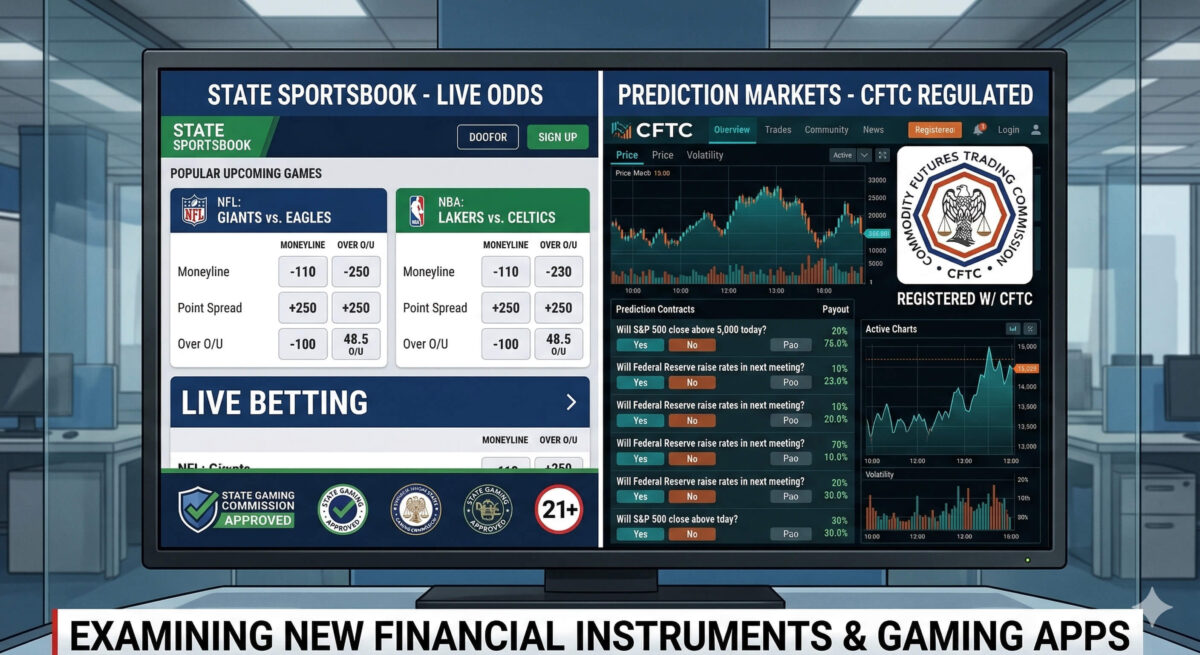
If you can legally bet $100 on the Knicks at FanDuel in New York—but face legal risk for buying a $0.60 “Yes” contract on the same game outcome from a prediction market—you’re looking at the fault line regulators are now fighting over.

This isn’t theoretical anymore. In March, Arizona filed criminal charges against Kalshi, a federally regulated exchange, while Major League Baseball signed a data partnership with a competing prediction platform. Same underlying activity, two completely different legal treatments.

The core dispute: Is this Gambling or Derivatives Trading?

Prediction markets let users trade “event contracts”—binary positions that settle at $1 or $0 depending on an outcome. In iGaming language, that looks a lot like a moneyline bet.

But the platforms reject that comparison.

Kalshi and others argue they’re offering financial derivatives, not wagers. The distinction matters because derivatives fall under the Commodity Futures Trading Commission (CFTC), not state gaming regulators.

The CFTC has leaned into that view. It has repeatedly asserted jurisdiction over event-based contracts, treating them more like commodities futures than sportsbook bets.

State regulators see it differently: if it walks like a bet and pays like a bet, it should be regulated like one.

Why do States see this as a Direct threat to Sports Betting

Since the 2018 repeal of PASPA, states have built tightly controlled sports betting ecosystems. Operators like DraftKings, FanDuel, and BetMGM operate under licenses that come with:

  • Tax rates as high as 51% (New York)
  • Responsible gambling mandates
  • KYC and geolocation requirements
  • Market access fees

Prediction markets bypass most of that structure.

As Stateline reported in early March, regulators argue these platforms are effectively offering betting products without paying licensing fees or taxes—and without the same consumer protections.

That’s not just a legal issue. It’s a revenue issue.

According to the American Gaming Association, legal sportsbooks generated over $10 billion in revenue in 2023. States take a significant cut. Prediction markets—regulated federally—don’t feed into that system.

From a state’s perspective, this looks like an unlicensed operator entering the market through a regulatory loophole.

Arizona’s Case: Escalation from Regulatory Dispute to Criminal Enforcement

Arizona’s charges against Kalshi mark a turning point. This isn’t a cease-and-desist or a civil dispute—it’s criminal prosecution.

The state argues Kalshi is offering illegal sports wagering. Kalshi argues it’s operating a CFTC-approved exchange.

According to reporting by the Wall Street Journal, Kalshi’s defense hinges on federal preemption—that CFTC oversight overrides state gambling laws.

This is where things get messy.

There is no clean precedent. Some courts have treated event contracts as legitimate derivatives. Others have allowed states to enforce gambling laws when the underlying activity resembles betting.

So right now, legality depends heavily on jurisdiction—and that’s exactly what both sides want to resolve.

Sports Leagues are No Longer Sitting on the Sidelines

For years, leagues treated betting as a reputational risk. That’s changed.

MLB’s recent partnership with a prediction market platform—and its agreement to share integrity data with the CFTC—signals a shift in strategy.

Leagues are no longer asking whether these markets should exist. They’re asking how to control them.

There’s a practical reason for that: integrity risk doesn’t care whether a wager happens on a sportsbook or a prediction market.

Recent investigations into suspicious betting activity have already shown how quickly edge cases—like prop bets or niche contracts—can become vulnerabilities.

Prediction markets expand that surface area.

A simple example shows why regulators are stuck

Take a standard outcome: “Knicks win tonight.”

  • On DraftKings: You place a regulated bet at -150 odds
  • On a prediction market: You buy a “Yes” contract at $0.60

Both imply roughly the same probability. Both pay out if the Knicks win.

But the regulatory treatment is completely different:

FeatureSportsbookPrediction Market
RegulatorState gaming authorityCFTC
TaxationState-levelNot state-based
AccessGeo-restrictedOften broader
SafeguardsRequiredLimited/unclear

From a user perspective, these products are interchangeable. From a legal perspective, they are not.

That mismatch is the root of the conflict.

The Uncomfortable Truth: Prediction Markets are Closer to Betting Than They Admit

Supporters argue prediction markets improve price discovery and aggregate information. There’s truth to that.

But once real money is involved, behavior starts to resemble betting—not forecasting.

Users chase odds. Liquidity clusters around popular events. Price swings often reflect sentiment, not fundamentals.

And unlike financial markets, there’s often no underlying asset or hedge—just an outcome.

That’s why regulators are skeptical. This isn’t hedging risk. It’s taking a position on an uncertain event, with payout tied to the result.

In other words: it looks a lot like gambling, even if it’s structured differently.

Where the Model Breaks Down: Manipulation and Uneven Rules

The biggest concerns aren’t theoretical—they’re operational.

  • Market manipulation: Large traders can move prices in thin markets
  • Information asymmetry: Participants may act on non-public or unverifiable signals
  • Behavioral risk: No consistent responsible gambling controls

Academic studies have shown that “whales” can temporarily distort prediction markets, especially when liquidity is low.

At the same time, sportsbooks are required to monitor for suspicious betting patterns and intervene when needed.

Prediction markets don’t face the same obligations.

That creates an uneven playing field—not just between operators, but in terms of consumer protection.

Practical Takeaways for Today

  • The US is heading toward a legal showdown between federal and state authority
  • Prediction markets currently operate in a gray zone—legal in some contexts, challenged in others
  • States view them as unlicensed sports betting competitors
  • The CFTC views them as legitimate financial instruments
  • Criminal enforcement (like Arizona’s case) raises the stakes significantly
  • Sports leagues are engaging with prediction markets instead of resisting them
  • Users should be aware that legality and protections vary depending on where they participate

The real battle isn’t about betting—it’s about control of the market

This fight isn’t just about whether prediction markets are “legal.”

It’s about who controls the next generation of wagering.

States built a regulated sports betting ecosystem with clear rules, high taxes, and tight oversight. Prediction markets challenge that model by offering a parallel system under federal jurisdiction.

If courts side with the CFTC, prediction markets could expand rapidly—potentially reshaping how Americans interact with risk, betting, and financial markets.

If states win, these platforms may be forced to either obtain gaming licenses or exit key markets entirely.

Either way, the line between trading and betting is no longer theoretical. It’s being redrawn in real time—and the outcome will decide who owns the future of iGaming in the US.

Hardik Dhawan