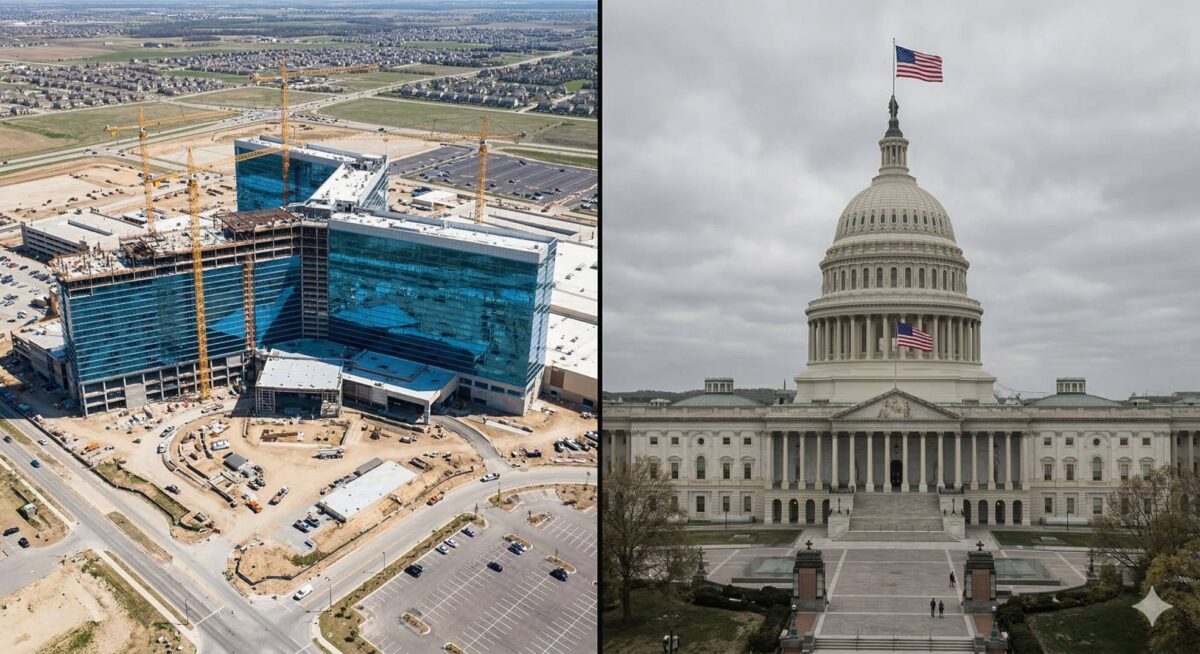


When Indiana Governor Mike Braun signed HB 1038 into law on March 4, he set off a chain of referendums that will determine whether Fort Wayne, a mid-sized manufacturing city in the state’s northeast corner, becomes home to a casino resort requiring a minimum $500 million capital commitment.
On the same day, Virginia’s House of Delegates passed SB 756 by a 64–32 margin, inching a Northern Virginia casino closer to reality after four consecutive years of legislative failure. These were not isolated events. Across at least six states this month, casino expansion legislation hit decisive inflection points, some advancing, some stalling, and at least one quietly getting worse for the communities it targets.
Indiana’s HB 1038 creates a new state casino license and places county-specific referendums on the November ballot for Allen, DeKalb, and Steuben counties. The financial stakes are significant: according to the bill’s fiscal impact statement, each casino could generate between $170 million and $230 million annually in adjusted gross receipts.
What’s analytically notable is what the bill deliberately excluded. A state-commissioned market study by Spectrum Gaming Group identified downtown Indianapolis as the top revenue location — yet the legislation excluded Indianapolis (Marion County) as a potential bidding location, despite that study ranking it highest by revenue potential.
The reason: cannibalization concerns from existing licensees, whose lobbying weight was sufficient to redirect expansion toward less competitive geography. This is a recurring pattern in US gaming legislation — the most economically rational site loses to incumbent protection.
The winning bidder faces a $150 million license fee and a $500 million minimum capital investment within five years. That financial floor effectively screens out smaller operators and narrows the real competition to a handful of large integrated resort companies.
Virginia’s SB 756 is now in conference, with chambers reconciling divergent versions of a bill that has died three times before. The House passed SB 756 on March 4 by a 59–37 margin after a reconsideration vote; the Senate then voted unanimously to reject the House version, sending it into a six-member conference committee.
The economic argument underpinning the bill has always been straightforward: a 2019 General Assembly-commissioned study predicted a Northern Virginia casino would generate $155 million in additional statewide gaming tax revenue annually — more than half the revenue projected across the other five studied localities combined — and retain roughly $100 million that Virginia residents currently spend at Maryland casinos.
Yet the latest conference substitute, passed by the Senate on March 13, introduced a provision that has hardened local opposition: the revised bill would allow a temporary casino in Fairfax County to operate for up to five years without a referendum, under approval from the state’s Major Employment and Investment Project Approval Commission.
Fairfax County Board Chairman Jeff McKay has signaled he will advocate for Governor Abigail Spanberger to veto the bill entirely. The bill’s trajectory — from a straightforward referendum-trigger mechanism to a state-override instrument — reflects how casino legislation mutates under political pressure.
On the online casino front, Maine became the eighth US state to legalize online casinos in early 2026, with Governor Janet Mills allowing LD 1164 to pass without her signature. Under the bill, the four tribes of the Wabanaki Nations can license online casino operators, with a 16% tax on revenue — but the state’s two commercial brick-and-mortar casinos were excluded, prompting Oxford Casino Hotel to file a federal lawsuit alleging unconstitutional discrimination.
That lawsuit encapsulates the central friction in US iGaming expansion: tribal exclusivity frameworks, designed to protect sovereign gaming interests, are increasingly colliding with commercial operators who have no equivalent protection. It is a structural conflict that will likely require federal litigation to resolve definitively.
The revenue logic driving these bills is not subtle. New Jersey’s total gaming revenue hit a record $6.98 billion in 2025, with online casino revenue reaching $2.91 billion — a 22% year-over-year increase and the first time in the state’s history that internet gaming income overtook land-based casino revenue. That data point is being cited in virtually every state legislative hearing on iGaming expansion as a proof-of-concept for tax yield without physical infrastructure.
Not every March 2026 casino story is about expansion. Maryland effectively shelved iGaming for the year after Governor Wes Moore declined to include online casino tax revenue in his 2026 budget, and both active bills failed to meet the March 17 crossover deadline.
Meanwhile, Mississippi, Iowa, and Oklahoma have moved aggressively to restrict sweepstakes casinos — the social gaming platforms that operate under dual-currency models and have, until recently, functioned in a regulatory gray zone across 45 states.
California and New York had already banned the dual-currency model at the start of the year. This crackdown is not incidental to casino expansion — it is structurally related to it. States that are pushing commercial iGaming have a strong incentive to eliminate unregulated sweepstakes competition that captures gambling demand without generating tax revenue.
The conventional concern about casino expansion is social — problem gambling rates, community disruption, traffic externalities. Those are real, but they are the arguments being made by community groups like the Tysons Stakeholders Alliance and Reston Association. The less-discussed risk for expert observers is fiscal cannibalization at the state level.
Indiana’s own analysis of why Indianapolis was excluded — existing licensees’ cannibalization concerns — reveals a structural contradiction in how states approach gaming expansion. Every new license competes with existing ones. The $170–$230 million annual gross receipts projection for an Indiana northeast casino will, to some degree, be drawn from the existing gaming revenue pool rather than created entirely from new demand. States rarely model this displacement honestly in fiscal impact statements, which tend to project gross new revenue without netting out erosion in existing licensee tax yield.
Virginia’s revenue projection gap is equally telling: the General Assembly’s 2019 study projected $53 million annually in Commonwealth revenue from a Fairfax casino; a 2025 consultant study commissioned by Fairfax County itself estimated only $53 million total — suggesting the earlier state figure may have been optimistically constructed to advance a political agenda rather than model market reality.
What March 2026’s casino legislation makes clear is that gaming expansion in America is no longer a story about new frontiers. It is increasingly about incumbent protection, revenue recapture from neighboring states, and the slow legislative attrition of unregulated digital competition.
Indiana spent three sessions figuring out how to add one license without threatening five others. Virginia spent four years trying to convince a county that doesn’t want a casino that it should have one anyway. Maine legalized iGaming and immediately faced a federal lawsuit from the operators it excluded.
The states that will expand gaming revenue most effectively in the near term are not those writing the most ambitious bills — they are the ones modeling cannibalization honestly, structuring referendums with enough democratic legitimacy to survive legal challenge, and building tax frameworks that don’t require a $3 billion capital commitment to pencil out.