World Cup betting markets are the different ways sportsbooks let users bet on matches, teams, players, groups, and tournament outcomes. U.S. sportsbook availability varies by state, so readers should check whether legal online sports betting is available where they are before comparing odds or placing a bet.
This guide explains the main World Cup betting markets, including match winner, futures, props, totals, group markets, and live betting. World Cup betting odds, market rules, and available World Cup betting sites can differ by sportsbook and state. Terms and odds should always be checked before betting.
What Are World Cup Betting Markets?
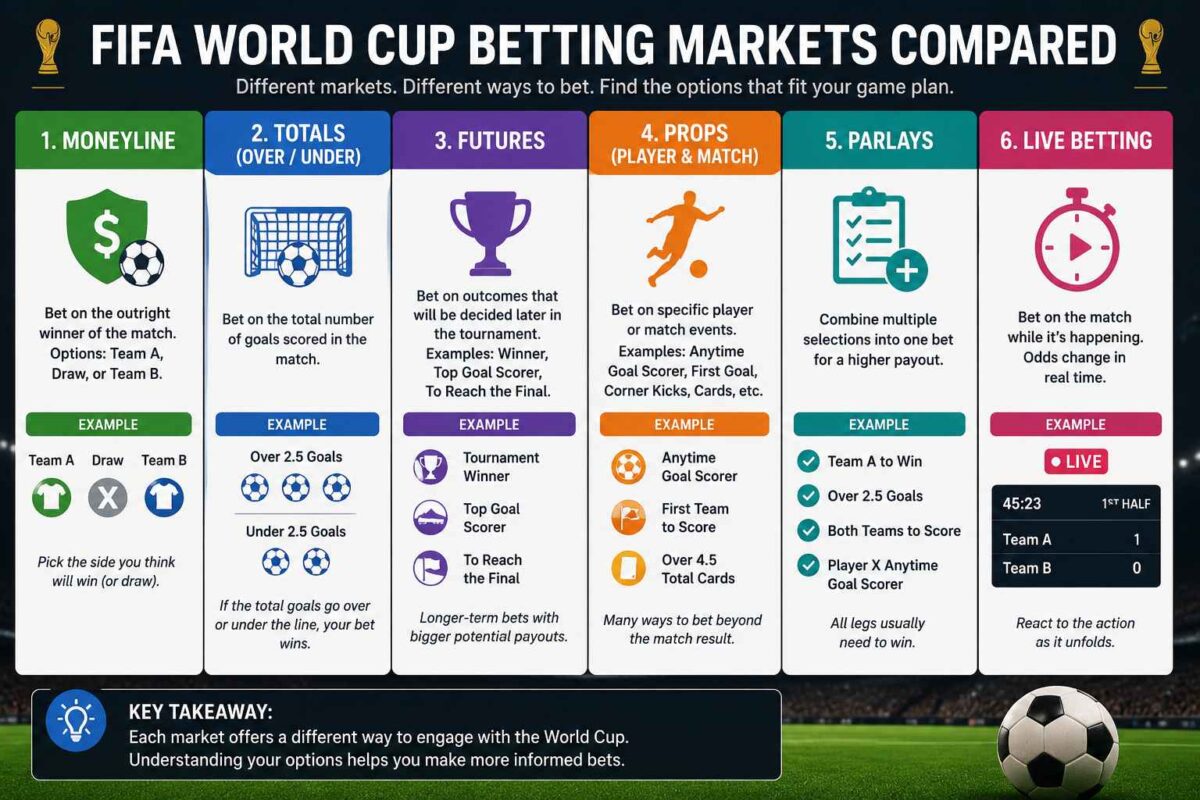
World Cup betting markets are the options sportsbooks offer for betting on World Cup matches and tournament outcomes. They can cover single matches, group results, player performance, team futures, and live in-game events.
A betting market is basically a question. The sportsbook might ask who will win a match, how many goals will be scored, which team will qualify, or which player will score.
World Cup betting markets can appear at different times. Some are posted months before the tournament. Others open before each match. Live betting markets update during the game.
Common soccer betting markets include:
Match result markets
Totals markets
Handicap/spread markets
Futures markets
Player prop markets
Group-stage and knockout markets
Live betting markets
Market availability can vary by sportsbook and state. A licensed sportsbook in New Jersey may offer a different menu than one in Ohio, Arizona, Colorado, or Massachusetts. Props and live markets can also depend on state rules, data availability, and the sportsbook’s approved market list.
Main World Cup Betting Markets Compared
Betting Market
What It Means
Example
Best For
What To Check
Moneyline / Match Winner
Pick which team wins
Team A to win
Simple match betting
Regulation vs extra-time rules
Draw
Bet on a tie after regulation
Match to end level
Soccer-specific outcomes
Whether draw applies to 90 minutes
Total Goals
Bet over/under a goal line
Over 2.5 goals
Goal-focused betting
Line, odds, and settlement rules
Spread / Handicap
Team gets a goal advantage/disadvantage
Team +1.5
Closer match pricing
Exact handicap rules
Futures
Bet on tournament outcomes
Team to win World Cup
Long-range betting
Odds movement and cash-out rules
Group Markets
Bet on group outcome
Team to win group
Tournament-stage betting
Tie-breaker and advancement rules
Player Props
Bet on player events
Player to score
Player-focused betting
Starting lineup and minutes risk
Live Betting
Bet during the match
Next goal, live total
In-game changes
Speed, odds movement, bet delays
Use this table to compare the main World Cup betting markets by what they mean, when they are useful, and what users should check before placing a bet.
World Cup markets should not be compared by odds alone. A higher price may come with more uncertainty, a narrower settlement rule, or a longer wait for the bet to settle. Before comparing World Cup betting odds, readers should understand what the market actually covers.
The 2026 World Cup uses an expanded 48-team format with 12 groups of four teams, followed by a 32-team knockout stage. That format affects group betting, qualification markets, futures, and “to advance” markets.
Match Winner, Draw, and 3-Way Betting
Match winner betting is one of the simplest World Cup betting markets, but soccer often includes a draw option. Users need to check whether the market is based on 90 minutes, extra time, penalties, or the official team advancement result.
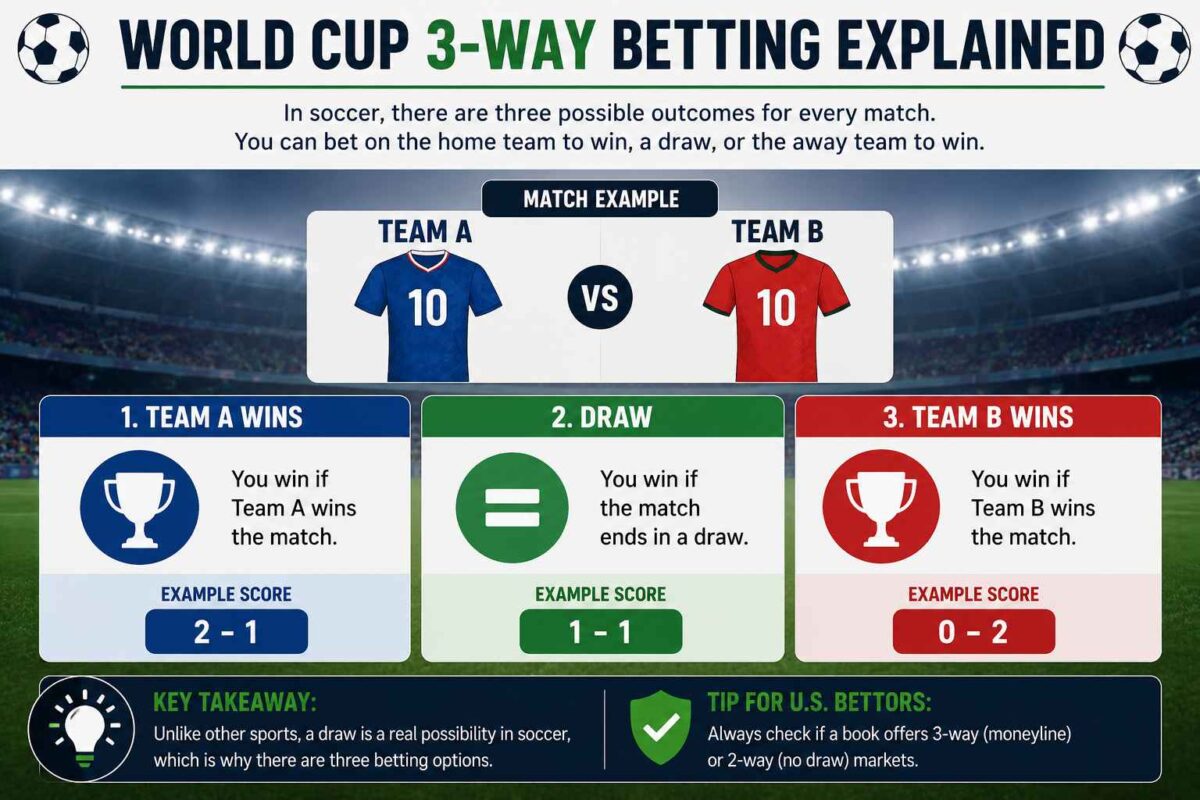
In U.S. sports betting, “moneyline” usually means picking the winner. In soccer, that can be slightly different because many match markets are 3-way bets.
A 3-way betting market has three possible outcomes:
Option
What It Means
Key Rule To Check
Team A wins
Team A wins within the stated settlement period
90 minutes or includes extra time
Draw
Match is tied after regulation if 3-way market
Whether draw is available
Team B wins
Team B wins within the stated settlement period
90 minutes or includes extra time
For World Cup match winner betting, the most important rule is settlement period.
Many soccer match markets settle after regulation time, including stoppage time, but not extra time or penalties. That means a knockout match can finish tied after 90 minutes even if one team later advances.
For example, a team could win a penalty shootout and advance, while the 90-minute match winner market settles as a draw. That is why “team to win,” “team to advance,” and “3-way betting” should not be treated as identical unless the sportsbook rules say so.
Totals, Both Teams To Score, and Goal Markets
Goal markets let users bet on how many goals are scored rather than only which team wins. These can include total goals, both teams to score, team totals, and exact-score markets.
World Cup totals betting usually uses an over/under line. If the line is 2.5 goals, over means the match needs at least three goals. Under means the match needs two or fewer.
Both teams to score is a yes/no market. The user is betting on whether each team scores at least once.
Market
Simple Meaning
Example
Complexity
Over/Under Goals
Bet whether total goals go above or below a line
Over 2.5 goals
Low/Medium
Both Teams To Score
Bet whether both teams score
Yes/No
Low/Medium
Team Totals
Bet on one team’s goal total
Team over 1.5 goals
Medium
Correct Score
Pick the exact final score
2-1
Higher
World Cup goal markets can be sensitive to small differences. A 2.0 goal line, 2.25 goal line, and 2.5 goal line may settle differently depending on sportsbook rules.
Correct score is usually a higher-complexity market because the bettor must pick the exact result. It may offer larger prices than broader goal markets, but that does not make it better or more suitable for every user.
Readers should check whether goal markets settle after 90 minutes or include extra time. This is especially important during knockout matches.
World Cup Futures Markets
World Cup futures markets are bets on tournament outcomes that settle later, such as the outright winner, group winner, finalist, or top goalscorer. These markets can change throughout the tournament cycle.
World Cup futures are usually available before the tournament starts and may remain available during the competition. Odds can move as squads are announced, injuries occur, group results change, and teams advance or are eliminated.
Futures Market
What It Means
What To Check
Outright Winner
Team wins the tournament
Current odds, draw path, squad news
To Reach Final
Team reaches the final
Bracket path and settlement rules
Group Winner
Team finishes first in group
Tie-breaker rules
Top Goalscorer
Player scores most goals
Starting role, injury status, tie rules
Stage of Elimination
How far a team goes
Exact stage definitions
The World Cup outright winner market is one of the most common futures markets. It settles when the tournament winner is confirmed.
Other World Cup futures markets may focus on how far a team goes. These can include to reach the quarterfinal, semifinal, or final. Users should check whether the sportsbook defines the market by official progression, match result, or another settlement rule.
Top goalscorer markets need extra care. Tie rules can vary. Some sportsbooks may use dead-heat rules, while others may use assists or minutes played as tie-breakers if listed in the rules.
Sportsbook market depth can vary widely, so readers comparing futures, props, and live markets may also want to review Best World Cup Betting Sites before choosing where to bet.
Group Stage and Knockout Stage Markets
Group-stage markets focus on standings and qualification, while knockout-stage markets often depend on whether the bet is settled after regulation time or after the team advances.
The 2026 World Cup format includes 12 groups of four teams. The top two teams in each group and the eight best third-place teams advance to the knockout stage.
That creates several World Cup group betting markets, including group winner, team to qualify, group points, exact group finish, and group forecast-style markets.
Stage
Common Markets
Main Rule To Check
Group Stage
Group winner, qualify, points total, exact finish
Tie-breakers and final group table rules
Round of 32 / Knockouts
To advance, match winner, win in regulation
Whether extra time and penalties count
Later Rounds
To reach semifinal/final, stage of elimination
Exact settlement definition
World Cup knockout betting needs careful reading. “To advance” usually means the team progresses to the next round, even if that happens after extra time or penalties.
That is different from a 90-minute match winner bet. In a knockout game, a team can advance without winning the 90-minute result.
Group markets also need tie-breaker awareness. Teams can finish level on points, and official tournament tie-breakers decide the final order. Users should check whether the sportsbook follows the official organiser’s official table or has special settlement rules.
Player Props and Team Props for the World Cup
World Cup player props and team props let users bet on specific events within a match, such as goals, shots, assists, cards, corners, or team totals. Availability can vary by sportsbook and state.
Player props are tied to individual performance. Team props focus on a team event or statistic.
Prop Type
Example
What To Check Before Betting
Player Scoring
Player to score anytime
Starting lineup and role
Shots
Player over/under shots
Minutes, position, matchup
Assists
Player to record assist
Set-piece role and team style
Cards
Player or team cards
Referee and rules where available
Team Goals
Team over/under goals
Opponent strength and market line
Clean Sheet
Team to allow no goals
Starting goalkeeper and defense
Soccer prop bets can be affected by lineups, injuries, rotation, tactics, and substitutions. A player who usually starts for a club may not have the same role for a national team.
Lineup verification matters. If a user bets a player prop before lineups are confirmed, they should understand what happens if the player does not start or does not play.
Some sportsbooks void certain props if a player does not start. Others may settle based on whether the player appears at all. The sportsbook’s house rules decide this.
Cards and corners may also be limited by state or sportsbook. Not every licensed sportsbook offers the same player and team props.
Live World Cup Betting Markets
Live World Cup betting markets update during matches as the score, time, red cards, injuries, and substitutions change. Users should understand that odds can move quickly and some bets may be delayed or suspended.
Live soccer betting is also called in-play betting. It can include:
Live match winner
Live total goals
Next team to score
Next goal time
Live corners/cards
Cash-out, if offered
In-play betting markets can shift immediately after a goal, red card, injury, substitution, or major tactical change. Sportsbooks may suspend betting while they update lines.
Bet delays are common. A user may click to place a live bet, but the sportsbook can hold the wager for a few seconds before accepting, rejecting, or repricing it.
Cash-out may be available at some sportsbooks, but it is not guaranteed. It can disappear when markets are suspended or when odds move quickly.
Users who want fast access on mobile should compare app speed, layout, and in-play market availability on best betting apps. Live betting can encourage quick decisions, so readers should set limits and avoid chasing losses.
How To Compare World Cup Betting Markets Before Betting
To compare World Cup betting markets, users should check odds, settlement rules, market availability, sportsbook licensing, and whether they can legally bet from their state.
Odds are only one part of the decision. A market with a slightly higher price may not be useful if the rules are unclear, the app is slow, or the bet type does not match what the user intended.
Bettors who are still learning how to bet on world cup matches should focus on legal access, market rules, and sportsbook licensing before comparing prices.
A practical checklist:
Check whether sports betting is legal in your state.
Compare odds across licensed sportsbooks.
Read the market settlement rules.
Check whether the market is for regulation time or qualification.
Confirm player lineups for props.
Review limits, bet delays, and cash-out rules.
Use responsible gambling tools if needed.
U.S. users should start with legal access. Sports betting is regulated state by state, and availability differs across markets such as New Jersey, Pennsylvania, Michigan, New York, Illinois, Ohio, Massachusetts, Arizona, Colorado, Tennessee, Virginia, Maryland, North Carolina, Louisiana, Indiana, Iowa, Kansas, and Kentucky. State rules can change, so users should verify current availability before betting.
Next, users can compare World Cup betting odds after they understand the market. A 90-minute moneyline, draw-no-bet market, and team-to-advance market may all involve the same teams, but they do not settle the same way.
Readers comparing market depth can also review World Cup betting sites, especially if they want futures, props, live markets, and mobile betting tools in one licensed account.
Responsible gambling tools are part of the comparison. Licensed sportsbooks may offer deposit limits, spending limits, time limits, cool-off periods, self-exclusion, and reality checks. These tools can help users keep betting within personal limits.
Common Mistakes To Avoid With World Cup Betting Markets
The biggest World Cup betting mistakes usually come from misunderstanding settlement rules, ignoring draw outcomes, or assuming every sportsbook offers the same markets.
Beginners do not need advanced betting theory to avoid common errors. They mainly need to read the market name, understand the settlement period, and confirm that the sportsbook is legal where they are located.
Common mistakes include:
Confusing match winner with team to advance
Ignoring draw markets
Betting player props before lineups are confirmed
Choosing futures only because odds are large
Assuming all U.S. states allow online sports betting
Not reading market settlement rules
The 90-minute vs advance distinction is especially important in knockout matches. “Team A to advance” may include extra time and penalties. “Team A to win in 90 minutes” usually does not.
Futures can also be misunderstood. Larger odds do not automatically mean better value. Futures prices can move because of injuries, squad news, group-stage results, bracket changes, and market demand.
Users should also avoid betting more quickly than they planned, especially during live betting. Setting limits before the tournament starts can reduce pressure during matches.
Are World Cup Betting Markets Legal in the United States?
World Cup betting markets may be available in the United States only where legal, licensed sports betting is offered. Availability depends on the user’s state, age, location, and the sportsbook’s approved market list.
Sports betting in the United States is regulated state by state. A user in one state may have several licensed online sportsbooks, while another user may have retail-only betting or no legal sports betting access.
Before betting, users should check:
Is online sports betting legal in the user’s state?
Is the sportsbook licensed in that state?
Is the user old enough to bet?
Does the sportsbook offer World Cup markets?
Does geolocation confirm the user is inside the legal state?
Licensed sportsbooks typically use geolocation checks to confirm that users are physically located in a legal betting state. Being a resident of a state is not always enough; location at the time of betting matters.
Minimum betting age also varies by jurisdiction, commonly 21 but not universally. Users should check their state’s regulator or sportsbook terms.
This section is practical guidance, not legal advice. Users should only use licensed sportsbooks where available and should review official state resources for current rules.
Responsible Gambling and Safer Betting Reminders
World Cup betting should be treated as paid entertainment, not a way to make money. No market, price, or bet type guarantees a profit.
Before betting, users can consider:
Setting a deposit limit
Setting a spending limit
Using time limits or session reminders
Taking a cooling-off period
Using self-exclusion if betting no longer feels controlled
Avoiding live bets made out of frustration
Not chasing losses after a losing bet
The National Council on Problem Gambling provides U.S. support resources for people affected by gambling harm. Users can also look for state-specific responsible gambling programs and sportsbook account tools.
World Cup Betting Markets FAQs
What are World Cup betting markets?
World Cup betting markets are the different betting options sportsbooks offer for World Cup matches and tournament outcomes. They can include match winner, draw, total goals, futures, group-stage markets, player props, team props, and live betting markets.
What is the most common World Cup betting market?
The most common World Cup betting markets are usually match winner, draw, and total goals. These markets are easier for beginners to understand than futures or player props, but users should still check whether the bet settles after 90 minutes or includes extra time.
What does 3-way betting mean in World Cup soccer?
3-way betting means there are three possible outcomes: Team A wins, the match ends in a draw, or Team B wins. In soccer, this usually applies to regulation time, so users should check whether extra time and penalties are included before betting.
What are World Cup futures bets?
World Cup futures bets are wagers on outcomes that settle later in the tournament. Examples include outright winner, group winner, top goalscorer, to reach the final, or stage of elimination. Futures odds can change as teams qualify, squads are announced, and matches are played.
Can I bet on World Cup player props in the United States?
You may be able to bet on World Cup player props in the United States if they are offered by a licensed sportsbook in your state. Availability can vary by sportsbook, state rules, player status, and tournament stage, so check the market list before betting.
Are World Cup betting markets legal in every U.S. state?
No, World Cup betting markets are not legal in every U.S. state. Sports betting rules vary by state, and users should only bet through licensed sportsbooks where online sports betting is legally available. Age and location checks usually apply.
Where can I compare World Cup betting odds?
Users can compare World Cup betting odds on licensed sportsbook apps or dedicated odds comparison pages. This guide explains the market types and rules, while an odds-focused page should help readers compare current prices where legal and available.
What should beginners check before betting on World Cup markets?
Beginners should check whether sports betting is legal in their state, whether the sportsbook is licensed, how the market settles, and whether the odds apply to regulation time or qualification. They should also read terms and use responsible gambling tools when needed.
I talk about stats like some folks talk about their favorite pizza toppings. Basketball and football are my jam, and i got a knack for digging up those juicy trends that make betting a bit less of a wild guess.



 nba
nba  soccer