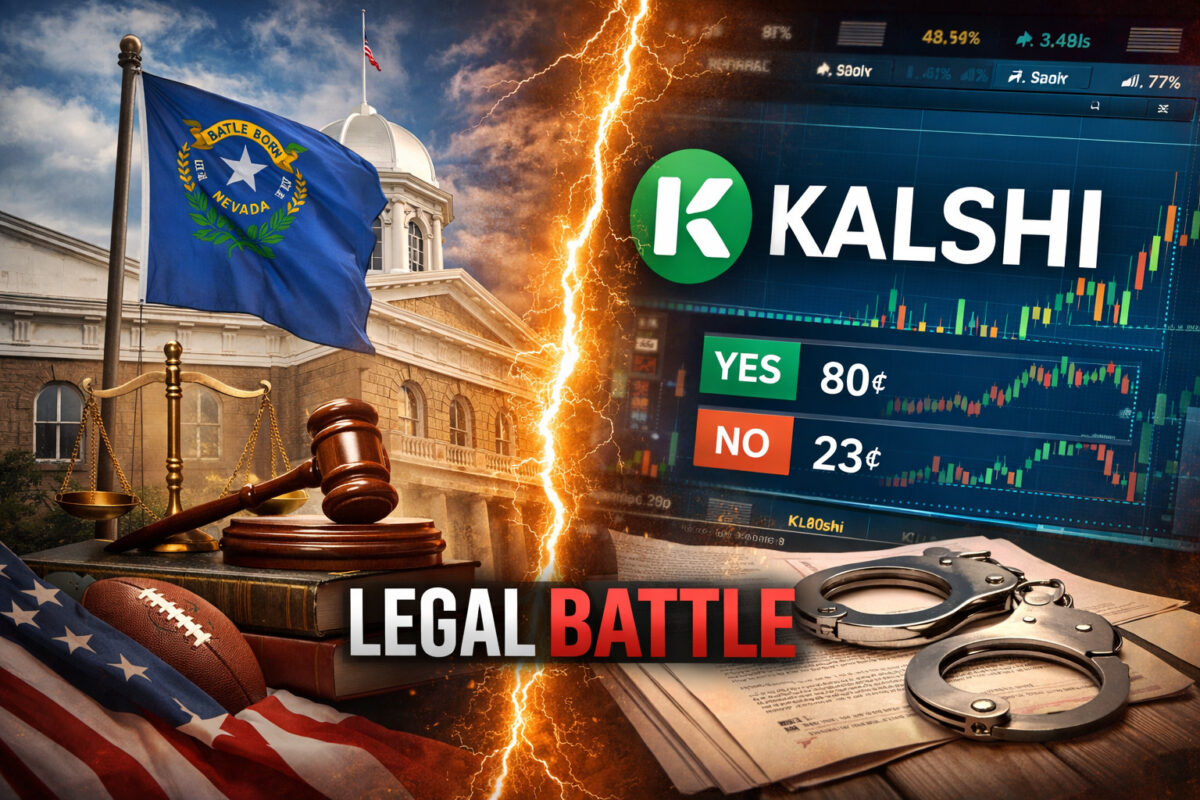


Nevada is intensifying its legal battle against prediction market operator Kalshi, marking a significant escalation in a dispute that could shape the future of “event contracts” in the United States. On February 17, 2026, the Nevada Gaming Control Board (NGCB) filed a civil enforcement action against Kalshi in Carson City District Court, seeking to block the company from offering certain types of contracts to Nevada residents that state officials say resemble unlicensed wagers under state law.
The lawsuit represents a major development in a months-long conflict between state regulators and a new class of prediction market platforms that offer trading on outcomes ranging from sports events to political results. It comes on the heels of a federal appeals court’s refusal to issue a stay that had briefly paused Nevada’s ability to act against Kalshi, a setback for the company’s legal team.
At the core of Nevada’s position is the claim that Kalshi’s sports and other event contracts amount to wagering as defined under Nevada gaming law, and therefore require a Nevada gaming license to be offered legally within the state. Regulators argue that the contracts allow residents to speculate on event outcomes in a manner similar to traditional sports betting — and that Kalshi has been doing so without complying with state safeguards meant to protect consumers and maintain the integrity of Nevada’s regulated gambling industry.
In its state-court complaint, Nevada is seeking a declaration and injunction that would prohibit Kalshi from offering these event contracts to people in the state, including contracts tied to major sports competitions. The NGCB also describes Kalshi’s continued operation as creating unfair competition for licensed sportsbooks that must comply with strict regulations, including age restrictions and measures against insider wagering or match-fixing.
NGCB Chairman Mike Dreitzer stated that the board is committed to “uphold[ing] the integrity of a thriving gaming industry,” underscoring the gravity with which the state views the potential impact of Kalshi’s activities on Nevada’s core economic sector.
Kalshi has consistently countered that its event contracts are not traditional bets but financial instruments, specifically swaps regulated federally by the Commodity Futures Trading Commission (CFTC). Under this view, Kalshi argues that only federal law applies to its products and that state enforcement actions are preempted. That position has been backed — at least in broader legal filings — by the CFTC, whose chairman has asserted that prediction markets fall within the agency’s exclusive jurisdiction.
However, the U.S. Court of Appeals for the Ninth Circuit recently denied Kalshi’s request for an administrative stay that would have blocked Nevada from moving forward with enforcement while broader appeals play out. With that temporary legal shield removed, Nevada acted quickly to bring its civil suit.
Kalshi has responded by seeking to have the Nevada case transferred to federal court, reiterating its federal-jurisdiction argument. The company maintains that its event contracts should be governed by federal commodities law rather than state gaming statutes.
Nevada’s move is not occurring in isolation. States from Massachusetts to others across the country have taken aim at Kalshi and similar platforms like Polymarket and Coinbase’s event markets, alleging that these offerings equate to illegal gambling when accessible to residents. In fact, a Massachusetts Superior Court judge recently issued a preliminary injunction against Kalshi’s sports-related markets in that state.
Meanwhile, federally the CFTC has weighed in publicly, backing prediction markets in the face of state crackdowns amid claims that prediction contracts facilitate legitimate hedging and forecasting, not unregulated gambling.
The civil enforcement action now moves the fight into Nevada state courts even as related federal appeals continue. Legal analysts believe the constellation of overlapping lawsuits — at both state and federal levels — could eventually lead to a higher court ruling, potentially by the U.S. Supreme Court, on whether and how prediction markets should be regulated in the United States.
For Kalshi, the stakes are monumental: either the company will be forced to comply with a patchwork of state gaming laws similar to traditional sportsbooks or, if its federal preemption argument prevails, it could continue operating nationwide under CFTC oversight without requiring state licenses. Either outcome could fundamentally reshape the future of online prediction markets.