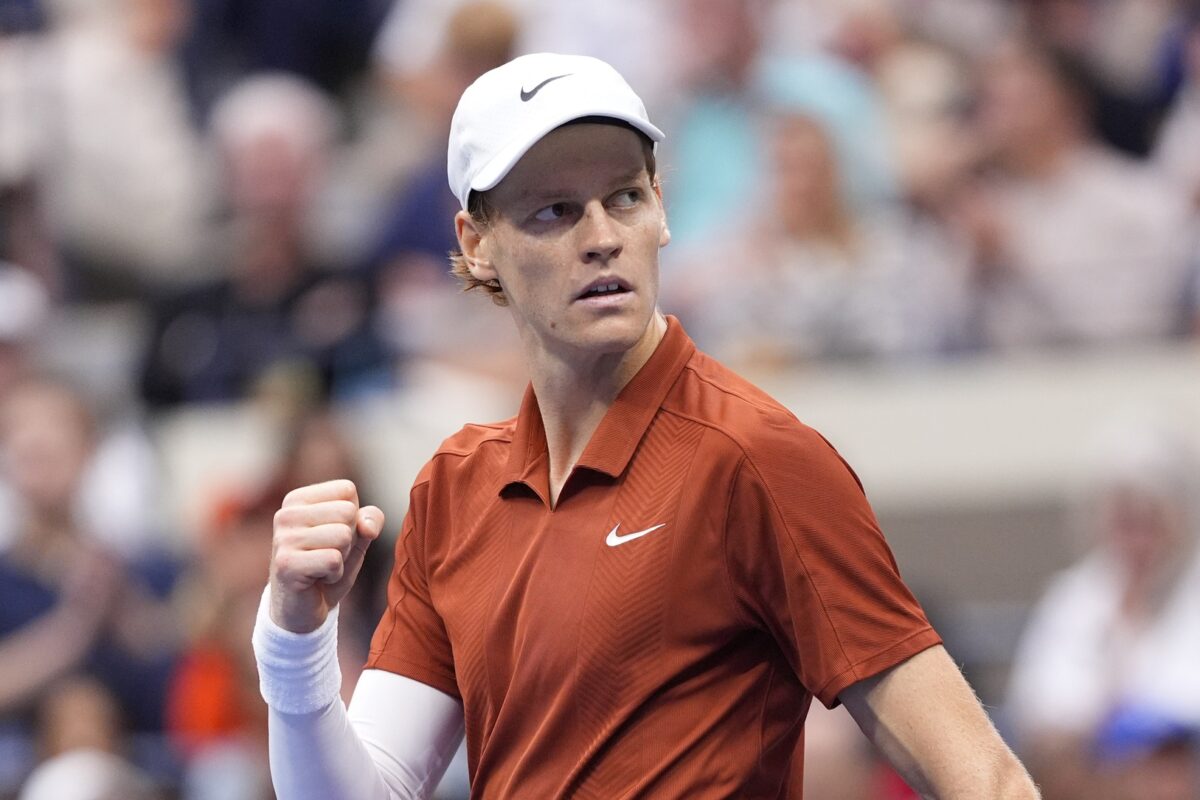
Sinner reflects on Federer’s critique, noting hard courts often play very similarly.
Jannik Sinner has acknowledged that hard courts today often produce very similar game situations, agreeing with Roger Federer’s recent critique of tournament surfaces. Speaking at his China Open pre-tournament press conference on Wednesday, Sinner highlighted that, aside from a few exceptions like Indian Wells, the conditions across hard courts offer minimal variation, leaving players to adapt within largely uniform settings.
“The hard courts, they are at times very similar. At times, there are some small changes, a couple of changes. One tournament that comes up a bit is Indian Wells because the ball bounces very high. It’s a bit different how the ball reacts with the court,” Sinner said, as per Sports Illustrated. “But yeah, if not, we have more or less similar game situations on the court. This is how it has been for a long time, like this. I don’t know if there is going to be a change or not. I’m just a player who tries to adapt myself in the best possible way. I feel like I’m doing a good job in this. But let’s see what the future can give us in every tournament.”
🇮🇹 Jannik Sinner agrees with Roger Federer that the hard courts on tour play too similarly:
— Olly Tennis 🎾🇬🇧 (@Olly_Tennis_) September 24, 2025
“The hard tracks are very similar to each other. There are times when there are a couple of changes, small changes.
“A tournament that comes to mind is Indian Wells, because the ball… pic.twitter.com/iGPfHqGbL0
Federer’s comments came last weekend on “Served with Andy Roddick” Podcast at the Laver Cup, where the 20-time Grand Slam champion suggested that tournament directors sometimes favor slower surfaces to protect notable matchups, such as Alcaraz vs. Sinner in finals.
“I understand the safety net that tournament directors see in making the surface slower,” Federer explained. “For the weaker player he has to hit extra amazing shots to beat Sinner, whereas if it’s quick he can maybe blast a few at the right time and he gets past. That’s why the tournament directors are like, ‘Oh I kind of like to have Sinner and Alcaraz in the finals.’ It kind of works for the game.”
🎙️🇨🇭Roger Federer not a fan of slowed down courts on tour:
— Tennis Masterr (@tennismasterr) September 22, 2025
"That's why we, the tournament directors, we need to fix it. We need to have not only fast courts, but what we would want to see is Alcraz or Sinner figure it out on lightning fast and then have the same match on super… pic.twitter.com/OvEMOq7jrO
Federer argued for more diversity in conditions to truly test players. “We need to have not only fast courts, but what we would want to see is Alcaraz or Sinner figure it out on lightning fast and then have the same match on super slow and see how that matches up,” he said.
Sinner, who dropped to ATP World No. 2 after losing to Alcaraz in the 2025 US Open final, has otherwise enjoyed a strong season with two titles (Australian Open and Wimbledon) and a 37-5 record. After reorganizing his training team and adjusting his play style post-New York, Sinner begins his China Open campaign against Marin Cilic in the Round of 32 on Thursday.
🤔 Roger Federer claims tournament directors are preparing slower courts to benefit Jannik Sinner & Carlos Alcaraz.#Tennis #JannikSinner #CarlosAlcaraz #RogerFederer pic.twitter.com/6icrSvg1Kr
— Tennis365 (@tennis365com) September 23, 2025
By voicing measured agreement with Federer, Sinner underscores a growing conversation in tennis: whether surface uniformity limits unpredictability and adaptability, and whether elite players are being challenged to their full potential across tournaments. If not, then there is should be an alternative for fair competition and better play.
Mandatory Image Credit: Robert Deutsch-Imagn Images
nfl
mma I’m an academic turned sports writer from Raipur, India, specializing in the NFL, MMA, and tennis at The Playoffs. I previously wrote for Sportskeeda and hold a B.A. and M.A. in History. My journey into sports media began far from the field, rooted in the arts and sciences. Funny enough, I didn’t grow up a sports fan; I used to see it all as just noise. But a fateful writing job introduced me to the world of sports, and what began as a gig quickly became a passion. I understood those voices aren’t noise; they’re emotions of true sports fans, and now I am one of them, writing with the same energy I once questioned.
Read moreWe use cookies for ads and to improve your experience. By continuing on the site, you agree to our Privacy Policy. Read more about it