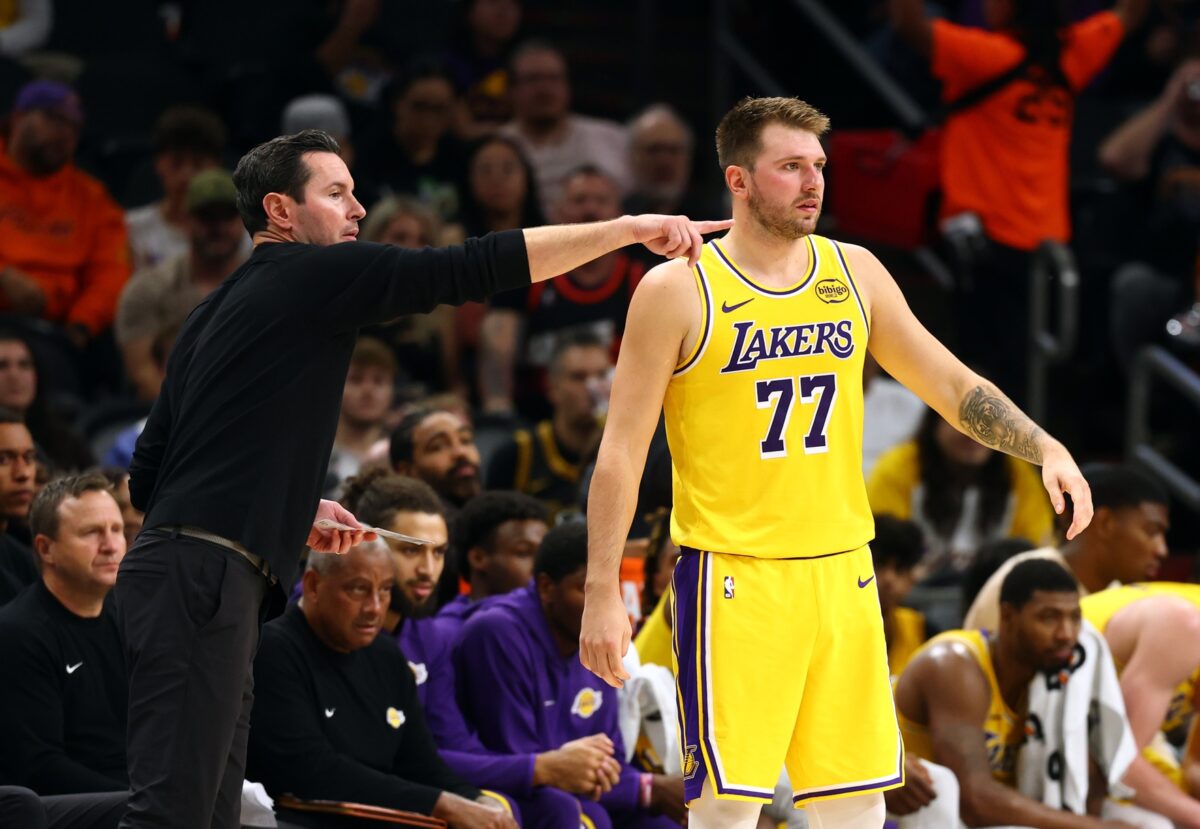


The Los Angeles Lakers enter the 2025–26 season with a retooled roster built around Luka Doncic, LeBron James, and Deandre Ayton, blending superstar talent with versatile role players and developing prospects. With LeBron managing injuries and the team leaning on Doncic to drive the offense, head coach JJ Redick has emphasized balance, defense, and lineup flexibility.
The depth chart reflects that approach as proven players like Marcus Smart, Jarred Vanderbilt, and Austin Reaves are expected to anchor key roles, while younger names such as Bronny James, Dalton Knecht, and Christian Koloko will be tested in supporting spots. This mix of established stars and emerging contributors gives the Lakers both immediate firepower and long‑term presence.
Luka Doncic: The Lakers’ blockbuster addition has already shown why he’s the centerpiece of this roster. In his preseason debut against the Phoenix Suns, Luka Doncic scored 25 points in 22 minutes, adding 7 rebounds and 4 assists while shooting 4-of-8 from three.
The Lakers were +11 with him on the floor despite losing the game. His ability to control tempo and create offense is exactly what the team lacked last season. Conditioning was a concern in Dallas, but he arrived at preseason camp in noticeably better shape. The offense will run through him, and his chemistry with Austin Reaves and Ayton in pick-and-rolls is already a preseason highlight.
Gabe Vincent: After an injury-plagued 2023–24, Vincent bounced back last season as a steady backup guard. He’s expected to replay that role this year. Reports from camp suggest he feels more comfortable with Jarred Vanderbilt back healthy, since Vanderbilt’s defense allows Vincent to play more freely. Vincent’s shooting has been streaky, but his playoff experience with Miami still makes him a trusted rotation piece.
Austin Reaves / Nick Smith Jr.: Austin Reaves is primarily starting at shooting guard, but his versatility allows him to slide over and handle point guard minutes when Luka Doncic sits. He’s already shown strong chemistry with Deandre Ayton in pick-and-roll actions.
Nick Smith Jr., signed to a two-way deal in late September, is more of a developmental option. He averaged nearly 10 points per game with the Charlotte Hornets last year but struggled with efficiency. For now, he’s insurance depth and likely to split time with South Bay in the G League.
Austin Reaves: Reaves continues to prove he’s more than just a role player. In the preseason win over Golden State, he led the Lakers with 21 points on 7-of-10 shooting. His offensive aggression has stood out, and he’s meshing well with Luka Doncic and Deandre Ayton. With LeBron sidelined to start the season, Reaves’ scoring load will increase. His ability to create off the dribble and space the floor makes him a natural fit next to Doncic.
Marcus Smart: Signed this offseason, Smart’s role is still being defined. Reports note he’s unsure whether he’ll start or come off the bench, but his defensive presence is non-negotiable. The Lakers brought him in specifically to address perimeter defense, which was a glaring weakness in last year’s playoff exit. Even if his offensive game is inconsistent, his leadership and toughness are valuable.
Bronny James / Gabe Vincent: Bronny James is entering his second season and remains a work in progress. He’s shown flashes defensively but has struggled with shooting consistency in preseason. JJ Redick has emphasized conditioning as the key for him to earn a steady role. For now, he’s likely to split minutes between the Lakers and South Bay. Vincent, as mentioned, can also slide into this spot when needed, giving the team a veteran option if Bronny isn’t ready for extended minutes.
Rui Hachimura: Hachimura’s role has been one of the most debated topics this preseason. Some reports suggest he’s favored to start because of continuity with the core group, while others argue his defensive limitations make him better suited as a bench scorer.
With LeBron James sidelined to start the season, Hachimura has been asked to step up offensively. He’s coming off a season where he shot 41% from three and averaged 12.6 points per game, making him a reliable floor‑spacer. The question is whether he can hold up defensively against elite wings.
Jake LaRavia: Signed this offseason, Jake LaRavia has impressed in camp with his pace and shooting. He’s a career 42.9% three‑point shooter, and has already shown flashes in the NBA preseason, scoring 10 points with solid defense against Golden State. At just 23, he’s seen as a connector piece, not a high‑usage scorer, but someone who can complement stars by spacing the floor and defending multiple positions.
LeBron James: Officially listed at power forward, LeBron James will still see minutes at the three when matchups dictate. However, his sciatica issue means the Lakers are easing him in. When healthy, his playmaking from the wing remains unmatched, but the team is clearly preparing for stretches without him.
LeBron James: Even at 40, LeBron James remains the Lakers’ best option at the four. His ability to initiate offense from the high post and punish mismatches is still elite. The concern is durability, he’ll miss the start of the season with sciatica/nerve irritation in his glute, and the Lakers will manage his minutes carefully.
Jarred Vanderbilt: Vanderbilt is finally healthy after two injury‑plagued years. Reports from camp highlight his defensive energy, with JJ Redick experimenting by using him as a full‑court ball‑hawk alongside Marcus Smart. In preseason, he’s looked active, posting 9 points, 7 rebounds, 4 assists, and 3 steals against Golden State. His offensive limitations remain, but his defense is too valuable to ignore.
Maxi Kleber / Rui Hachimura: Maxi Kleber is recovering from a quad tweak, but when available, he provides floor spacing and rim protection. His ability to defend bigger forwards makes him a useful rotation piece. Rui Hachimura, if not starting at the three, can also slide up to the four, giving the Lakers flexibility depending on matchups.
Deandre Ayton: Ayton is the Lakers’ starting center and defensive anchor. In the October 12 preseason win over Golden State, he put up 14 points, 8 rebounds, 5 assists, 2 steals, and 1 block on 6-of-8 shooting. JJ Redick has emphasized rim protection and rebounding as his priorities, and Ayton has embraced that role, saying he wants to “let the league know I’m the Lakers’ center and anchor of this defense”. He won’t be asked to score 20 a night, but his efficiency and presence inside are vital.
Jaxson Hayes: Hayes returns as the backup five after adding 20 pounds of muscle this offseason to improve his physicality. He’s still best as a rim‑runner and lob threat, especially in pick‑and‑rolls with Luka Doncic. Last year, he was phased out of the playoff rotation, but the Lakers expect his added strength and pace to keep him in the mix for 12–15 minutes per game.
Jarred Vanderbilt: Though primarily a forward, Vanderbilt has been used as a small‑ball center in preseason. Redick has experimented with him as a full‑court disruptor alongside Marcus Smart, using his length and defensive versatility to pressure ball‑handlers. He won’t provide much scoring, but his defense and rebounding make him a situational option at the five.
Christian Koloko: Signed on a two‑way deal, Christian Koloko is a developmental piece. At 7’0” with a defensive pedigree from Arizona, he offers rim protection and length. He’s expected to spend time with South Bay in the G League, but could see spot minutes if injuries hit.

 nba
nba  nfl
nfl  wnba
wnba 
 Washington Wizards
  Charlotte Hornets
  Philadelphia 76ers
  Brooklyn Nets
  Toronto Raptors
  Miami Heat
  Chicago Bulls
  Atlanta Hawks
  Orlando Magic
  Detroit Pistons
  Milwaukee Bucks
  Indiana Pacers
  New York Knicks
  Boston Celtics
  Cleveland Cavaliers
  Utah Jazz
  New Orleans Pelicans
  San Antonio Spurs
  Portland Trail Blazers
  Phoenix Suns
  Dallas Mavericks
  Sacramento Kings
  Memphis Grizzlies
  Golden State Warriors
  Minnesota Timberwolves
  LA Clippers
  Denver Nuggets
  Los Angeles Lakers
  Houston Rockets
  Oklahoma City Thunder
  NBA
NBA