The online betting industry has evolved dramatically over the past decade. What was once a fragmented sector with varying rules and limited digital infrastructure has become a highly competitive global ecosystem shaped by regulation, technology, and user expectations.
Yet not all betting markets offer the same experience. Some regions prioritize consumer protection and responsible gambling, while others focus on market competition and product innovation. For bettors, the overall experience depends on a combination of factors including regulation, payment systems, promotional transparency, market variety, mobile usability, and customer safeguards.
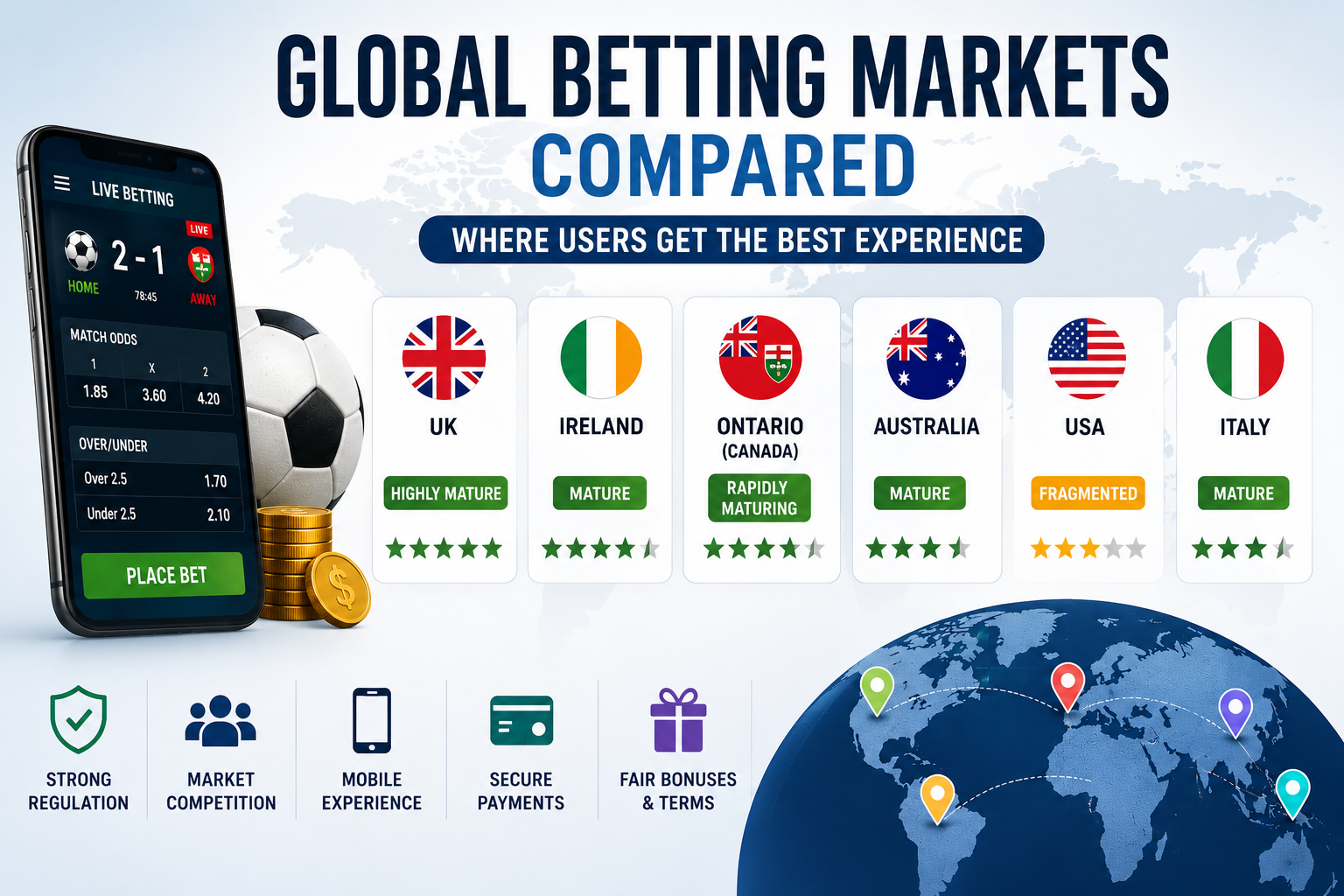
Markets such as the United Kingdom, Ireland, and Ontario are often viewed as mature betting jurisdictions because they combine legal oversight with widespread consumer participation and established operator competition. Emerging markets, meanwhile, continue adapting to changing legislation and digital betting trends.
Understanding how these regions compare provides useful insight into where bettors encounter the most balanced and reliable experiences.
What Defines a Mature Betting Market?
A mature betting market is not simply one with a large number of sportsbooks. Instead, maturity usually reflects how developed the regulatory environment, infrastructure, and user protections have become over time.
Several factors contribute to market maturity:
Transparent licensing systems
Consumer protection rules
Responsible gambling measures
Competitive operator landscape
Stable payment processing
Advanced mobile betting platforms
Clear advertising standards
In mature markets, users typically benefit from stronger safeguards and more predictable betting experiences.
Comparing Major Betting Markets
The global betting landscape varies significantly from region to region. Some jurisdictions have decades of established regulation, while others only recently legalized online sportsbooks.
Comparative Overview
Market
Regulation Strength
Market Competition
Responsible Gambling Focus
Mobile Experience
Market Maturity
United Kingdom
Very High
Very High
Very High
Excellent
Highly Mature
Ireland
High
High
Growing
Excellent
Mature
Ontario (Canada)
High
High
High
Excellent
Rapidly Maturing
Australia
High
Moderate
Moderate
Strong
Mature
United States
Varies by State
High
Developing
Strong
Fragmented
Italy
High
Moderate
High
Good
Mature
Each market has developed differently depending on local laws, taxation systems, and consumer behavior.
The United Kingdom: The Benchmark for Regulation
The United Kingdom is widely considered one of the world’s most developed betting markets. The country has a long history of legalized gambling, and the UK Gambling Commission plays a central role in regulating operators and enforcing consumer protection standards.
The UK’s betting ecosystem benefits from:
Strict licensing requirements
Advertising oversight
Mandatory affordability considerations
Self-exclusion systems
Strong dispute resolution mechanisms
The UK Gambling Commission continues to update policies aimed at reducing gambling harm while maintaining competitive market standards.
Why Users Often Prefer the UK Market
The UK market stands out because of its balance between competition and oversight. Bettors generally have access to:
Numerous licensed operators
Competitive odds
Sophisticated mobile apps
Extensive sports coverage
Transparent bonus disclosures
At the same time, stricter compliance rules have made operators more cautious regarding promotions and customer verification procedures.
Ireland’s Betting Market: Competitive and Familiar
Ireland has one of Europe’s strongest betting cultures, especially in horse racing and football. The market has traditionally been closely connected to the UK ecosystem, with many operators serving both jurisdictions.
Irish users benefit from:
Broad sportsbook choice
Strong mobile betting adoption
Competitive promotional offers
Extensive racing markets
At the same time, Ireland’s regulatory framework is evolving. New gambling legislation aims to modernize oversight and strengthen player protection standards.
The Irish User Experience
Many bettors in Ireland value convenience and sportsbook variety. Comparisons between operators often focus on payment flexibility, market depth, and bonus structures. Informational resources discussing topics such as Betting sites in Ireland guide frequently examine how operators differ in terms of usability, wagering conditions, and market availability.
The wider Irish betting conversation, including platforms like Toffeeweb, often highlights how user experience increasingly depends on transparency rather than simply promotional size.
Ontario: Canada’s Fast-Growing Regulated Market
Ontario has rapidly become one of the most closely watched betting jurisdictions in North America. Since launching its regulated online gambling framework, the province has attracted numerous international operators while implementing structured consumer protection rules.
The province operates under iGaming Ontario and the Alcohol and Gaming Commission of Ontario (AGCO).
What Makes Ontario Different?
Ontario’s regulated market combines several strengths:
Clear licensing structure
Legal advertising framework
Broad sportsbook availability
Modern mobile-first betting platforms
Strong emphasis on responsible gambling
Unlike the fragmented U.S. system, Ontario provides a province-wide framework that creates greater consistency for users. Ontario’s rise also shows how a regulated market can mature quickly when licensing, consumer protection, and operator competition develop together. For readers following the Canadian market more closely, theplayoffs Canada is a useful reference point for Ontario-focused betting coverage, especially around how local rules and market competition shape the overall user experience.
User Experience in Ontario
Ontario bettors generally benefit from:
Streamlined onboarding
Regulated payment processing
Reliable identity verification
Wide sports coverage
High-quality live betting products
Media outlets such as theplayoffs.news/ca-on have also covered how Ontario’s rapid expansion is influencing competition between operators and shaping the broader Canadian betting landscape.
Australia: Mature but Restrictive
Australia has one of the world’s most active sports betting audiences, particularly around horse racing, rugby, and cricket. The market is highly developed technologically, with strong mobile integration and extensive live betting interest.
However, Australia also imposes restrictions that differ from Europe.
Key Australian Characteristics
Australian betting regulation includes:
Restrictions on inducements in certain states
Limitations on credit betting
Tight rules around live online betting
Strong emphasis on identity verification
Despite these restrictions, Australian users still enjoy highly polished sportsbook interfaces and extensive sports coverage.
Where Australia Excels
Australian operators often perform strongly in:
Mobile usability
In-play data integration
Racing coverage
Same-game betting features
However, promotional flexibility is generally more limited than in European markets.
The United States: Large but Fragmented
The U.S. sports betting market has expanded rapidly since the repeal of PASPA in 2018. Yet unlike centralized systems in the UK or Ontario, the American market remains fragmented because each state regulates betting independently.
Why User Experiences Vary
In the United States, bettors encounter different rules depending on location.
Some states allow:
Extensive promotional activity
Online casino integration
Broad sportsbook competition
Others apply:
Strict advertising rules
Limited operator licenses
Higher tax burdens
This inconsistency creates varying user experiences nationwide.
Strengths of the U.S. Market
Despite fragmentation, the U.S. market excels in:
Product innovation
Broadcast integration
Live betting technology
Promotional competition
Many operators invest heavily in app development and user engagement features.
Italy and Continental Europe
Italy represents a more tightly regulated European betting market. Advertising limitations and consumer protection laws have shaped how operators interact with users.
Other European countries such as Germany, Sweden, and the Netherlands also apply different rules regarding promotions, licensing, and player protection.
Common European Trends
Across continental Europe, regulators increasingly focus on:
Bonus transparency
Responsible gambling controls
Advertising restrictions
Deposit monitoring
This has shifted many operators toward more compliance-focused user experiences.
What Actually Creates a Better User Experience?
A good betting experience is not only about odds or bonuses. Mature markets tend to succeed because they provide consistency and trust.
Factors Users Care About Most
1. Reliable Payments
Fast deposits and withdrawals remain essential.
2. Licensing Transparency
Users prefer clearly regulated operators.
3. Mobile Optimization
Most betting activity now occurs on smartphones.
4. Fair Bonus Terms
Simple conditions improve user confidence.
5. Responsible Gambling Tools
Deposit limits and self-exclusion options matter increasingly.
According to guidance from organizations such as GamCare, responsible gambling tools are becoming central to modern betting regulation.
Key Differences Between Mature and Emerging Markets
Mature Markets Usually Offer:
Better consumer protection
Stable payment systems
Clear legal frameworks
Established dispute procedures
Sophisticated betting products
Emerging Markets Often Face:
Regulatory uncertainty
Limited operator oversight
Payment processing issues
Inconsistent enforcement
As regulation improves globally, many emerging regions are gradually adopting standards already common in the UK, Ireland, and Ontario.
How Regulation Shapes User Confidence
One major difference between markets is how secure users feel when placing bets.
Well-regulated jurisdictions often provide:
Complaint resolution systems
Strict operator audits
Responsible gambling enforcement
Financial safeguards
These systems may not always be visible to users directly, but they significantly impact long-term trust in betting platforms.
The Future of Global Betting Markets
The betting industry continues evolving rapidly, especially as regulators respond to concerns around advertising, affordability, and gambling harm.
Future developments will likely include:
Greater AI-driven fraud monitoring
Enhanced affordability checks
Stricter advertising standards
More personalized responsible gambling tools
Continued mobile-first innovation
Markets that balance innovation with consumer protection will likely provide the strongest long-term user experiences.
Conclusion
There is no single “best” betting market globally because user priorities differ. Some bettors value promotional competition, while others prioritize safety, regulation, or mobile functionality.
The United Kingdom remains one of the most mature and structured markets worldwide due to its extensive regulation and operator competition. Ireland continues offering a highly competitive environment with growing regulatory modernization. Ontario has emerged as one of North America’s most promising regulated jurisdictions thanks to its centralized framework and strong oversight.
Meanwhile, Australia and the United States demonstrate how technological innovation can thrive even under very different regulatory models.
Ultimately, the strongest betting experiences tend to emerge in markets where regulation, transparency, and competition evolve together rather than independently.
FAQs
What is considered a mature betting market?
A mature betting market typically has strong regulation, consumer protections, stable licensing systems, and widespread operator competition.
Why is the UK betting market so influential?
The UK market is highly regulated and has decades of legal betting history, making it one of the most developed betting ecosystems globally.
How does Ontario differ from U.S. betting markets?
Ontario uses a centralized provincial framework, while U.S. betting regulation varies by state.
Are betting experiences better in regulated markets?
Global Editorial Chief of The Playoffs, I created The Free Agent, which became The Playoffs FR, in 2020 during the pandemic. A longtime fan of the four major American sports, I now oversee the editorial strategy and social media for all versions of The Playoffs. I still occasionally write about sports I’m particularly passionate about, such as the NFL or MLB. If there’s one thing you should remember: Eli Manning is the true GOAT for beating Tom Brady twice.



 nba
nba  nfl
nfl  mlb
mlb  nhl
nhl