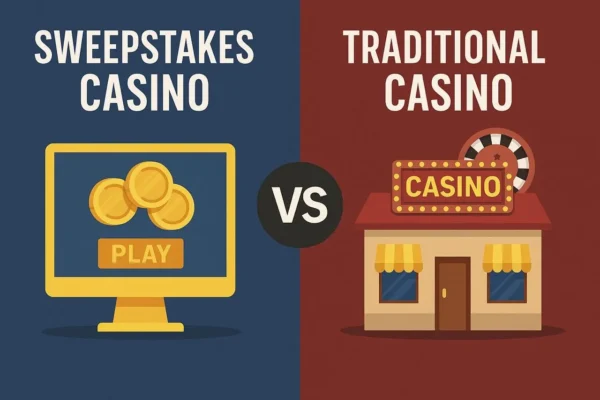


Reward-based gaming, often described as “social casinos” or “sweepstakes casinos”, has become a widely discussed corner of US online entertainment. The format has also drawn a wave of state-level scrutiny. This explainer covers why it has grown, how it works and where US rules stand, and it is written for readers in Ontario who follow the US market. It is informational only, and nothing in it applies to Ontario’s regulated market.

Most sweepstakes-style platforms run on two virtual currencies. One is bought or granted for play and cannot be cashed out. The other is distributed alongside purchases or through promotions and can be redeemed for prizes. According to law firm ZwillGen, operators argue that neither loop is gambling on its own, because purchases of the first currency award no prizes and play with the second is nominally without payment.
Regulators in several US states disagree, and that disagreement is at the centre of the current debate.
Several factors explain the attention. The first is access. Only a minority of US states license online casinos, so a product available nationally filled a gap for many users.
The second is design. Platforms borrow from mobile gaming, with daily log-in mechanics, loyalty tiers, challenges and referral features that keep users returning. The third is the redemption feature, which lets a balance of prize currency be converted after conditions are met, subject to verification.
| Feature | What users see | What to check |
|---|---|---|
| Two currencies | One for play, one redeemable | How each is obtained |
| Loyalty features | Tiers, challenges, referrals | Terms and eligibility |
| Verification | ID check before redemption | Age limits, often 21+ |
| Availability | Varies by state | Restricted-state lists |
For readers who want to see how this segment is covered for a US audience, ToffeeWeb publishes more information on US social casinos. The page is written for US residents and is not a regulated Ontario product list.
The same site also has a page with chanced casino welcome no deposit bonus. It is directed at US residents only, is not an Ontario-registered operator, and is included here as information, not as a recommendation to use it.
The growth has not gone unchallenged. California’s AB 831, signed on October 11, 2025 and effective from January 1, 2026, prohibits operating or supporting dual-currency “online sweepstakes games” that simulate gambling in the state, with misdemeanour penalties of up to one year in jail and $25,000 per violation, according to ZwillGen. The law also reaches vendors such as payment processors and content suppliers.
California is part of a broader trend. The same analysis describes New Jersey’s ban on most dual-currency sweepstakes, a bill passed by New York’s legislature, platform exits from West Virginia after attorney general subpoenas, and cease-and-desist letters in Maryland and Michigan. Because the picture changes quickly, the status in any given state should be checked against current official sources.
None of the above applies to Ontario. Online gambling in Ontario is limited to operators registered with the Alcohol and Gaming Commission of Ontario (AGCO) that have agreements with iGaming Ontario, and the permitted categories include online casino, poker, sports betting, bingo and betting exchange. The AGCO publishes its rules for operators on its internet gaming page.
Platforms that are not registered in Ontario are not part of the regulated market. Anyone who wants to confirm whether a site is regulated can check the list of operators on iGaming Ontario’s website.
Further information on this topic is available from The Playoffs’ page on online casinos in Ontario.
The legal age for online gambling in Ontario is 19.
Three questions will shape the US market: whether more states follow California’s approach, how courts treat the promotional-sweepstakes argument, and whether operators change their products to remain compliant. For consumers, the practical point is unchanged: understand what any product involves, set limits, and treat gambling as entertainment.
You must be 19 or older to take part in online gambling in Ontario. Gambling can be addictive. Set limits, never chase losses and play only with money you can afford to lose. Free, confidential support is available from ConnexOntario at 1-866-531-2600 or at www.connexontario.ca.
It is a casino-style website or app that uses two virtual currencies: one for play only and one that can be redeemed for prizes.
Only some states license online casinos, and these platforms borrow design features from mobile gaming.
No. California, New Jersey and other states have moved to ban or restrict it, and several operators have left certain states.
No. Ontario has its own regulated market overseen by the AGCO and iGaming Ontario, and the legal age is 19.
ConnexOntario offers a free, confidential helpline at 1-866-531-2600.
For information only. 19+ in Ontario. Gambling can be addictive. Please play responsibly. Support: ConnexOntario 1-866-531-2600, www.connexontario.ca.